
Oil prices remain one of the most important variables influencing the global petrochemical industry.
When crude oil prices rise, the impact can move through the energy and chemical value chain, affecting feedstocks, production costs, transportation, margins and eventually the prices paid by downstream buyers.
But the relationship is not always straightforward.
A higher oil price does not automatically mean that every petrochemical product will increase by the same percentage. The final market impact depends on feedstock structure, regional supply and demand, production capacity, inventories, logistics and the ability of producers to pass higher costs on to customers.
In 2026, this relationship has become particularly important as petrochemical markets deal with higher energy and feedstock costs alongside uneven downstream demand and continuing supply-chain challenges. Recent market analysis has shown that higher crude prices are pushing up petrochemical feedstock costs while weak demand is limiting the ability of producers to fully pass those costs through to customers.
Why Oil Prices Matter to the Petrochemical Industry
Crude oil is not simply an energy commodity.
It is also the starting point for a significant portion of the world's chemical and petrochemical value chain.
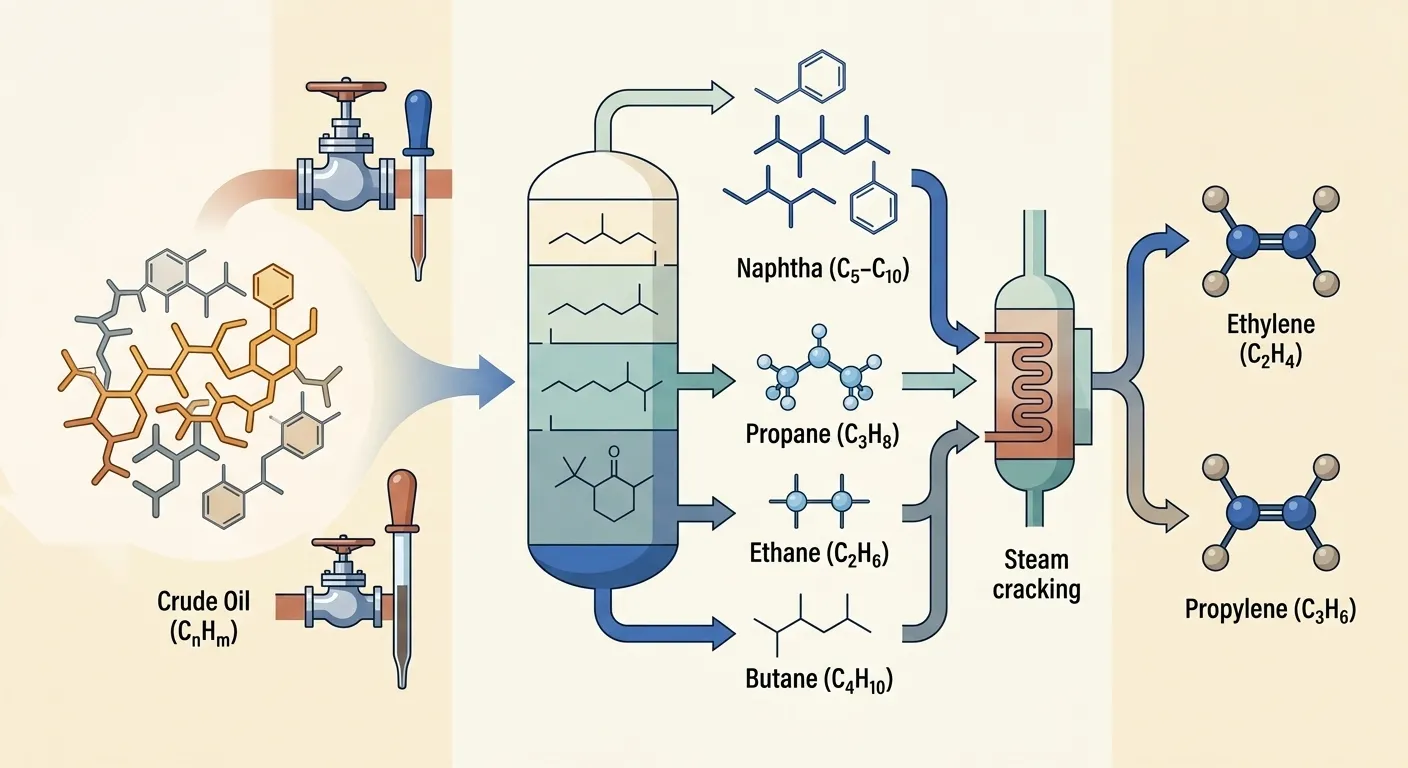
Oil can be processed into feedstocks such as naphtha, which is then used to produce important building blocks including ethylene and propylene.
These intermediates can subsequently be converted into products such as:
- Polyethylene
- Polypropylene
- PVC
- Styrene products
- Synthetic materials
- Solvents
- Aromatics
- Other chemical intermediates
This creates a broad connection between crude oil markets and petrochemical markets.
A simplified chain looks like this:
Crude Oil → Refining → Petrochemical Feedstocks → Basic Chemicals → Polymers & Derivatives → Finished Products
However, every stage has its own supply-and-demand dynamics.
That is why changes in crude prices do not always translate directly into equivalent changes in finished petrochemical prices.
For international buyers, understanding this chain is particularly important because the final purchasing cost can be influenced by much more than the supplier's initial product quotation.
The Role of Naphtha and Other Feedstocks
One of the most important transmission mechanisms between crude oil and petrochemicals is feedstock pricing.
In many regions, naphtha is a major feedstock for steam crackers producing olefins such as ethylene and propylene.
When crude prices rise, naphtha prices can also increase, raising the cost base for petrochemical producers.
Other feedstocks, including LPG components such as propane and butane, can follow different pricing dynamics.
This creates an important competitive relationship between feedstocks.
For example, when naphtha becomes particularly expensive, some producers may evaluate alternative feedstocks where their equipment and regional economics allow it.
Recent market data from Asia shows how quickly this transmission mechanism can operate. Higher crude prices in September 2026 were accompanied by stronger naphtha, propane and other feedstock prices, while constrained supply added further pressure to petrochemical markets.
Higher Oil Prices Do Not Affect Every Petrochemical Product Equally
It is tempting to assume that if crude oil rises by 10%, petrochemical products should also rise by 10%.
In practice, the market does not work that way.
Different products have different feedstock structures, production technologies and market balances.
For example, a polymer market may experience higher production costs at the same time that downstream demand remains weak.
In such a situation, producers face a difficult choice:
Increase prices → risk losing demand
or
Absorb higher costs → accept lower margins
This is one reason why petrochemical markets can behave differently from crude oil markets.
Recent market conditions illustrate this tension. In Asia, higher crude and feedstock costs have been accompanied by relatively weak demand in several downstream markets, creating pressure on margins and encouraging some producers to consider operating-rate reductions.
Crude Oil, Petrochemical Prices and Producer Margins
The most important variable for a producer is not necessarily the selling price of the finished product.
It is the relationship between:
Selling Price – Production Cost = Margin
If crude oil and feedstock prices rise faster than petrochemical selling prices, margins become compressed.
Producers may respond by:
- Reducing operating rates
- Delaying production
- Cutting output
- Seeking cheaper feedstocks
- Increasing selling prices
- Focusing on higher-margin products
- Adjusting inventory levels
These decisions can eventually affect regional supply availability.
This is why a period of higher oil prices can sometimes lead to tighter petrochemical supply even when end-user demand has not increased significantly.
For buyers, this is one reason why monitoring only the headline oil price can provide an incomplete picture of the market.
Why Weak Demand Changes the Picture
The current petrochemical market demonstrates an important principle:
Higher costs do not automatically create higher demand.
If manufacturers and consumers are already facing weak economic conditions, they may not be able to absorb significantly higher prices.
This can create a difficult environment for petrochemical producers.
The upstream cost of production rises, but downstream customers resist higher prices.
As a result, the market can experience rising production costs without an equivalent increase in finished-product prices.
This is particularly relevant in 2026, when some petrochemical and polymer markets continue to face structural oversupply and uneven downstream consumption even as feedstock costs rise.
What Does This Mean for Polyethylene and Polypropylene?
Polyethylene (PE) and polypropylene (PP) are among the world's most widely used polymers.
Their markets are closely connected to the cost of petrochemical feedstocks, but they are also heavily influenced by downstream demand from:
- Packaging
- Construction
- Automotive
- Consumer goods
- Agriculture
- Industrial manufacturing
When crude and feedstock prices rise, producers face higher costs.
However, if packaging manufacturers and other downstream industries are unwilling or unable to pay more, the increase may not fully pass through the supply chain.
This can create a gap between production economics and market pricing.
Recent Asian market data shows this clearly: higher feedstock costs have supported PE and PP prices, while weak margins have put pressure on some downstream polymer producers.
For international buyers, this means that monitoring crude oil alone is not enough.
A buyer should also watch feedstocks, polymer inventories, production rates and downstream demand.
For buyers evaluating polymer procurement, our article on Petrochemical Supply Chains Under Pressure in 2026 provides additional context on logistics, supply availability, freight costs and supply-chain resilience.

What About PVC?
PVC provides another useful example of why petrochemical pricing is more complicated than simply following crude oil.
PVC can be produced through different production chains, and its economics are influenced by factors including ethylene, chlorine, electricity, regional production capacity and construction demand.
As a result, crude oil can be an important market signal without being the only factor determining PVC prices.
Recent Asian market conditions have also shown rising PVC production and delivery costs alongside higher ethylene values, tighter feedstock availability and longer transit times.
This distinction is particularly important for international buyers.
A buyer evaluating PVC should consider the complete market structure rather than assuming that a movement in Brent crude will automatically produce an identical movement in PVC.
For buyers interested in the practical aspects of purchasing PVC from the Iranian market, our guide PVC Supply from Iran: Grades, Applications, Packaging & Export Considerations can be used alongside this market analysis.
Solvents and Aromatics Can Also Feel the Impact
The relationship between crude oil and solvents is also significant.
Many industrial solvents are derived from hydrocarbon and petrochemical streams.
Aromatic compounds such as benzene, toluene and xylenes are particularly connected to refinery and petrochemical feedstock economics.
Changes in crude prices can therefore influence:
- Feedstock costs
- Refinery economics
- Aromatics production
- Transportation costs
- Solvent production costs
However, regional supply, inventory and industrial demand still determine the final market outcome.
This is why buyers should evaluate solvent markets using both energy-market indicators and chemical-market fundamentals.
For a more practical look at solvent types, applications, packaging and international procurement, see our article Solvent Supply from Iran: Types, Applications, Packaging & Export Considerations.
Transportation Adds Another Layer of Cost
Oil prices do not only affect petrochemical production.
They can also influence transportation costs.
Higher energy prices can increase the operating cost of:
- Trucks
- Rail transportation
- Cargo vessels
- Storage facilities
- Port operations
- Industrial handling equipment
For international cargoes, this can create a second transmission mechanism:
Higher Crude Prices → Higher Feedstock Costs
and potentially:
Higher Crude Prices → Higher Transportation Costs
The combined effect can increase the landed cost of petrochemical products even if the supplier's original product price has changed only modestly.
This is especially important when international supply chains are already under pressure. Changes in shipping routes, freight rates, transit times and cargo availability can create additional costs beyond the product itself.
Our detailed guide on Cross-Border Transportation of Petroleum & Industrial Products from Iran examines some of the practical logistics considerations involved in international petroleum and industrial cargo movements.

Why Landed Cost Matters More Than the Headline Price
For international buyers, the most useful number is often not the quoted product price.
It is the expected cost of receiving the product at the final destination.
A simplified calculation can include:
Product Price + Packaging + Inland Freight + Ocean Freight + Insurance + Customs + Handling = Landed Cost
This is especially important when oil prices and freight markets are volatile.
A supplier with a lower FOB price may not necessarily offer the lower delivered cost if transportation requirements are significantly more expensive.
The choice of Incoterm can also change how costs, risks and responsibilities are allocated between buyer and seller.
Our guide FOB vs. CFR vs. CIF: Understanding Incoterms for International Buyers explains these differences in greater detail.
Understanding landed cost is therefore essential when comparing offers from different suppliers or different origins.
Regional Markets Can React Differently
Another important feature of the petrochemical market is regional divergence.
The same crude oil price can affect Asia, Europe, the Middle East and North America differently.
Why?
Because each region has its own:
- Feedstock structure
- Refining capacity
- Petrochemical capacity
- Import requirements
- Export availability
- Energy costs
- Transportation infrastructure
- Currency conditions
- Downstream demand
For example, a producer with access to relatively competitive feedstock may respond differently from a producer dependent on more expensive imported feedstocks.
This means that international buyers should avoid treating the global petrochemical market as a single market.
Regional price differences can create different procurement opportunities, but they can also reflect differences in freight, availability, quality specifications and delivery risk.
The Importance of Feedstock Flexibility
Feedstock flexibility is becoming increasingly important for petrochemical producers.
Where technically possible, producers may compare different feedstocks based on:
- Availability
- Price
- Yield
- Product mix
- Energy efficiency
- Transportation requirements
This flexibility can influence regional competitiveness and eventually affect global trade flows.
When one feedstock becomes significantly more expensive or difficult to obtain, producers with alternative feedstock options may have greater flexibility in managing production economics.
For international buyers, this reinforces the importance of looking beyond crude oil and monitoring the specific feedstock structure behind each product.
What Should Petrochemical Buyers Monitor?
International buyers do not need to follow every market indicator.
A practical monitoring framework can focus on several key variables.
1. Crude Oil Prices
Brent and WTI remain useful indicators of broader energy-market conditions.
2. Feedstock Prices
Naphtha, propane, ethane and other relevant feedstocks can provide a more direct indication of petrochemical production costs.
3. Production Rates
Operating-rate changes can signal tightening or loosening supply.
4. Inventory Levels
High inventories can limit the ability of producers to raise prices even when production costs increase.
5. Downstream Demand
Construction, packaging, automotive, agriculture and consumer manufacturing can all influence demand for different petrochemical products.
6. Freight Costs
Shipping and inland transportation can significantly change the final economics of an international transaction.
7. Regional Price Differences
Comparing different markets can reveal opportunities, supply constraints and differences in delivered economics.
A useful way to organize these indicators is:
Crude → Feedstock → Production → Inventory → Demand → Freight → Landed Cost
This gives buyers a more complete view of the factors behind a quotation.

What Does This Mean for International Trade?
When energy prices become volatile, international petrochemical trade can become more complex.
Buyers may reconsider:
- Supplier selection
- Contract timing
- Purchase quantities
- Inventory levels
- Delivery schedules
- Loading locations
- Transportation routes
- Incoterms
In some situations, purchasing smaller quantities at regular intervals may be preferable to committing to a large shipment at a highly uncertain market price.
In other situations, buyers may prefer to secure larger volumes when supply availability is more important than short-term price movements.
The appropriate strategy depends on the product and the buyer's consumption requirements.
This is where supply-chain planning becomes particularly important. As discussed in Petrochemical Supply Chains Under Pressure in 2026, international buyers increasingly need to consider not only product availability but also logistics, alternative routes and total delivered cost.
From Price Monitoring to Supply Planning
A modern petrochemical procurement strategy should not rely on a single market indicator.
Instead, buyers can build a broader picture:
Crude Oil → Feedstocks → Production Costs → Supply → Demand → Freight → Landed Cost
This approach provides a more realistic understanding of where market pressure is coming from.
It also helps buyers distinguish between a temporary price movement and a structural change in the market.
For example, a temporary rise in crude prices may have a different procurement implication from a sustained increase accompanied by lower inventories, restricted feedstock availability and higher freight costs.
The distinction can be important when negotiating contracts or planning inventory.
The Role of Trading and Supply Partners
In volatile markets, the role of an international trading partner can extend beyond finding a product and providing a quotation.
A capable partner may help coordinate:
- Product sourcing
- Specification matching
- Supplier communication
- Commercial negotiation
- Packaging
- Documentation
- Transportation
- Route planning
- Delivery coordination
For buyers operating across international markets, this coordination can reduce the complexity of managing several separate stages of a transaction.
The objective is not simply to find the lowest initial price.
It is to build a supply arrangement that balances price, specification, availability, logistics and reliability.
This approach is particularly relevant for products where different regional producers may offer different technical specifications or commercial conditions.
What Could Happen Next?
The direction of petrochemical markets will depend on how several variables evolve together.
If crude oil remains elevated while feedstock costs stay high, producers will continue facing pressure on margins.
If downstream demand improves at the same time, producers may have more ability to pass higher costs through the value chain.
If demand remains weak, however, higher production costs may instead result in reduced operating rates and tighter margins.
Current market conditions show that these factors can move in different directions at the same time: crude and feedstock costs can rise while downstream consumption remains relatively weak.
This creates several possible market outcomes rather than a single predictable direction.
For international buyers, flexibility and continuous market monitoring may therefore be more useful than relying on a fixed assumption about where prices are heading.
Conclusion
Rising oil prices are an important factor in the 2026 petrochemical market, but they are only one part of the equation.
The impact moves through a much broader system:
Crude Oil → Feedstocks → Petrochemical Production → Supply & Demand → Logistics → Landed Cost
At every stage, other factors can amplify or reduce the effect of higher crude prices.
This is why a rise in Brent does not automatically mean that every polymer, solvent or chemical product will rise by the same amount.
For international buyers, understanding these connections can lead to better purchasing decisions.
Instead of asking only:
“Where is the petrochemical price today?”
it can be more useful to ask:
“What is driving the price, how sustainable is that driver, and what will it mean for the delivered cost of the product?”
That broader perspective is becoming increasingly important as the global petrochemical industry navigates higher energy costs, changing feedstock economics, uneven demand and increasingly complex international logistics.
For companies purchasing petroleum and petrochemical products internationally, this broader view can help connect market intelligence with practical procurement and supply planning.
Frequently Asked Questions
How do rising oil prices affect petrochemical markets?
Higher crude oil prices can increase the cost of petrochemical feedstocks such as naphtha and influence transportation costs. However, the final effect on petrochemical prices depends on supply, demand, inventories, production rates and regional market conditions.
Do petrochemical prices always rise when oil prices rise?
No. Petrochemical prices do not necessarily move in direct proportion to crude oil prices. Weak demand, high inventories or excess production capacity can prevent producers from fully passing higher costs on to buyers.
What is the relationship between crude oil and naphtha?
Naphtha is a major refinery-derived feedstock used in petrochemical production, particularly in steam cracking. Its price is influenced by crude oil and refining economics, although regional supply and demand also play important roles.
How does crude oil affect polyethylene and polypropylene?
Higher oil and feedstock prices can increase production costs for polyethylene and polypropylene. However, actual polymer prices also depend heavily on inventories, production capacity and downstream demand.
Does crude oil directly determine PVC prices?
Not directly. PVC pricing is influenced by several factors, including ethylene or alternative production routes, chlorine, energy costs, production capacity, inventories and construction-related demand.
Why is landed cost important in petrochemical trading?
Landed cost considers the complete expense of receiving a product at its destination, including the product price, packaging, inland transportation, freight, insurance, customs and handling costs.
What should petrochemical buyers monitor in 2026?
Buyers should monitor crude oil, relevant feedstock prices, production rates, inventories, downstream demand, freight costs and regional price differences rather than relying on crude oil prices alone.
Can higher oil prices create tighter petrochemical supply?
They can. If production costs rise significantly and producers cannot pass those costs through to customers, some producers may reduce operating rates or output. This can tighten supply in particular markets.