
When buying petroleum, petrochemical, mineral, or other industrial products internationally, the product price is only one part of the transaction.
The Incoterm used in a sales contract can determine how transportation costs are allocated, when risk transfers from seller to buyer, and who is responsible for arranging freight and insurance.
Among the most commonly discussed terms in international maritime trade are FOB, CFR, and CIF.
Understanding the difference between them can help buyers evaluate quotations more accurately and avoid misunderstandings during shipment.
What Are Incoterms?
Incoterms® are standardized three-letter trade terms developed by the International Chamber of Commerce (ICC). They define important responsibilities between buyers and sellers, including obligations, costs, and the point at which risk transfers. The current edition is Incoterms® 2020.
FOB, CFR, and CIF belong to the group of Incoterms® rules intended for sea and inland waterway transport.
They should therefore not simply be treated as interchangeable price labels.
FOB: Free On Board
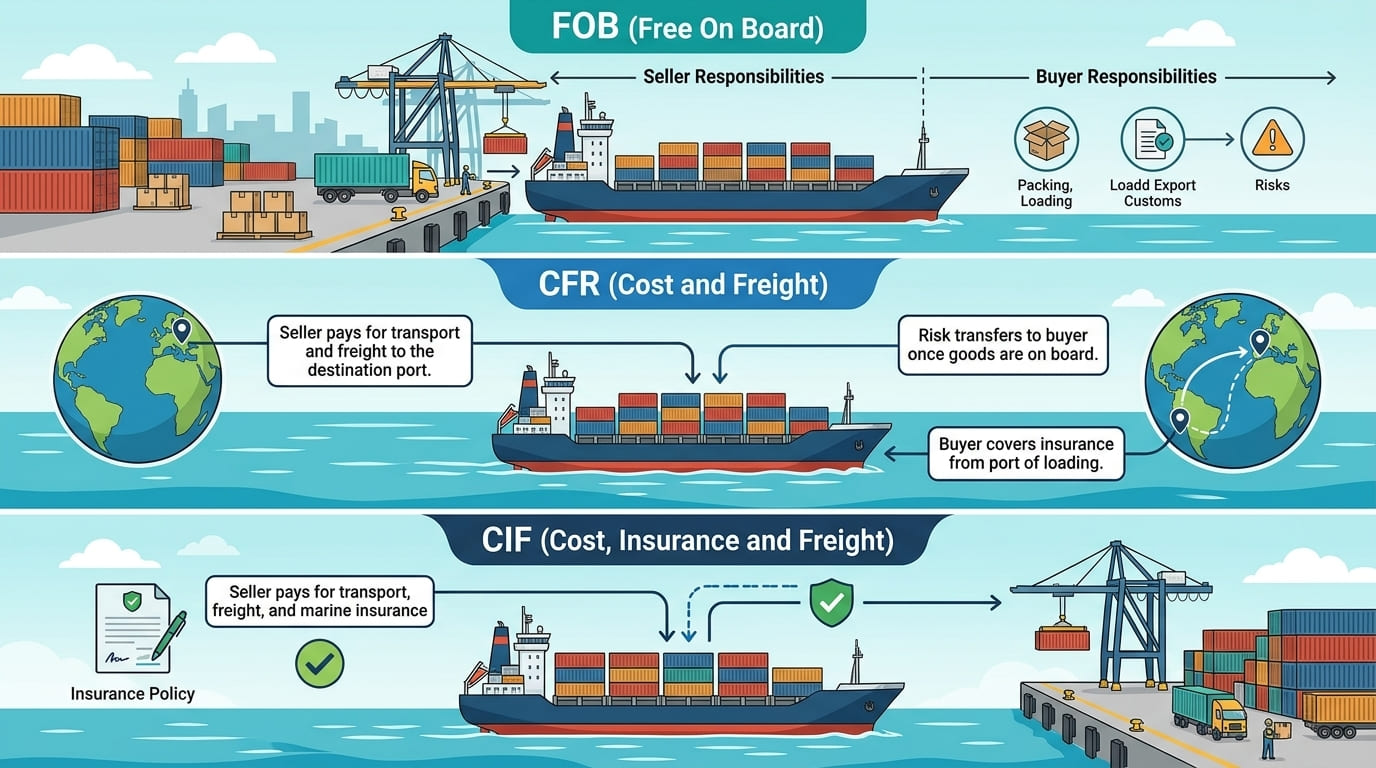
FOB — Free On Board means that the seller delivers the goods on board the vessel nominated by the buyer at the named port of shipment.
Under FOB, the risk of loss or damage transfers to the buyer once the goods are on board the vessel. From that point, the buyer generally bears the costs and risks associated with the shipment.
Under FOB
The seller generally handles:
-
Preparing the goods
-
Export clearance where applicable
-
Delivering the goods on board the vessel
-
Costs up to the agreed delivery point
The buyer generally handles:
-
Nominating the vessel
-
Main ocean freight
-
Insurance, if desired
-
Costs and risks after delivery on board
-
Import clearance and related destination costs
Example
Suppose a buyer purchases an industrial product on:
FOB Bandar Abbas
The seller's responsibility is to deliver the goods on board the nominated vessel at the agreed port.
The buyer then arranges the main ocean freight and manages the subsequent transportation and import process.
CFR: Cost and Freight
CFR — Cost and Freight goes one step further from a pricing perspective.
Under CFR, the seller delivers the goods on board the vessel and also contracts for and pays the freight necessary to transport the goods to the named destination port.
However, an important point is often misunderstood:
The seller paying the freight does not mean that the seller carries the transportation risk until arrival.
Under CFR, risk transfers when the goods are delivered on board the vessel at the port of shipment.
Under CFR
The seller generally handles:
-
Preparing the goods
-
Export clearance
-
Loading the goods on board
-
Arranging and paying the main freight to the named destination port
-
Providing the relevant transport document
The buyer generally handles:
-
Risk after the goods are on board
-
Insurance, if desired
-
Import clearance
-
Destination-related costs according to the contract and applicable arrangements
Example
A quotation might be:
CFR Jebel Ali
This means the seller includes the cost of ocean freight to Jebel Ali in the commercial price.
However, the risk does not remain with the seller until the cargo reaches Jebel Ali. The risk transfers when the goods are on board the vessel at the shipment port.
CIF: Cost, Insurance and Freight
CIF — Cost, Insurance and Freight is similar to CFR, but with an additional insurance obligation.
Under CIF, the seller contracts for and pays the freight to the named destination port and also obtains insurance coverage for the buyer's risk during carriage.
However, the risk itself still transfers when the goods are on board the vessel at the port of shipment.
Under CIF
The seller generally handles:
-
Preparing the goods
-
Export clearance
-
Loading the goods on board
-
Main ocean freight
-
Contracting for the required insurance
-
Transport documentation
The buyer generally handles:
-
Risk after loading on board
-
Import clearance
-
Import duties and taxes
-
Destination-related costs not allocated to the seller
Important Point About CIF Insurance
CIF does not automatically mean comprehensive insurance coverage.
Under Incoterms® 2020, the seller's insurance obligation under CIF is based on minimum cover requirements unless the parties agree on additional coverage. Buyers requiring broader protection should address this explicitly in the sales contract or arrange additional insurance.
FOB vs. CFR vs. CIF: Key Differences
| Item | FOB | CFR | CIF |
|---|---|---|---|
| Main freight paid by | Buyer | Seller | Seller |
| Insurance arranged by seller | No | No | Yes |
| Risk transfers | On board vessel | On board vessel | On board vessel |
| Export clearance | Seller | Seller | Seller |
| Main ocean freight included in seller's price | No | Yes | Yes |
| Suitable transport | Sea / inland waterway | Sea / inland waterway | Sea / inland waterway |
The critical point is that CFR and CIF include freight to the named destination port, but risk still transfers at the shipment port when the goods are on board the vessel.
Why the Cheapest Quotation Is Not Always the Cheapest Shipment
Consider three quotations for the same product:
FOB: $500/MT
CFR: $550/MT
CIF: $555/MT
At first glance, the FOB price appears cheaper.
But the buyer must also consider:
-
Ocean freight
-
Marine insurance
-
Destination charges
-
Port handling
-
Customs costs
-
Import duties and taxes
-
Inland transportation
-
Other applicable logistics costs
The final landed cost may therefore be very different from the initial product quotation.
This is why international buyers should compare quotations based on the complete cost structure, not only the price per metric ton.
FOB, CFR or CIF for Petroleum and Petrochemical Products?
The appropriate Incoterm depends on the commercial and logistics structure of the transaction.
For example, a buyer who has strong relationships with shipping companies and wants to control the main freight may prefer a structure where the buyer arranges the ocean transportation.
Another buyer may prefer the seller to coordinate the main freight and include it in the quotation.
A buyer may also require insurance to be included in the seller's offer, making CIF relevant where the transaction otherwise fits the CIF rule.
The important point is to determine who should control the transportation, who should bear the relevant costs, and where risk should transfer.
What Should Buyers Check Before Accepting an FOB, CFR or CIF Offer?
Before comparing supplier quotations, buyers should confirm several details.
1. Named Port
The exact port should be clearly identified.
For example:
FOB Bandar Abbas, Incoterms® 2020
or
CIF Jebel Ali, Incoterms® 2020
Using only "FOB" or "CIF" without specifying the relevant place can create unnecessary ambiguity.
2. Product Specification
The commercial offer should clearly identify:
-
Product
-
Grade
-
Specification
-
Quantity
-
Packaging
-
Origin
-
Required documents
3. Freight
For CFR and CIF quotations, buyers should understand what transportation costs are included and to which named destination port.
4. Insurance
For CIF transactions, buyers should confirm the insurance arrangement and whether additional coverage is required.
5. Destination Costs
A CFR or CIF quotation does not necessarily mean that all costs at the destination are included.
Port charges, customs clearance, duties, taxes, inland transportation, and other destination costs should be clarified separately.
A Common Mistake: Confusing Cost With Risk
One of the most important concepts in Incoterms is the difference between cost responsibility and risk transfer.
For example:
Under CFR, the seller pays the freight to the named destination port.
But the seller does not retain the transportation risk until the goods arrive there.
The risk transfers when the goods are delivered on board the vessel at the shipment port.
The same fundamental risk-transfer point applies to CIF.
This distinction is particularly important when negotiating international shipments of high-value petroleum, petrochemical, and industrial products.
FOB, CFR and CIF Are Not the Only Options
FOB, CFR, and CIF are only three of the eleven Incoterms® 2020 rules.
For containerized or multimodal transportation, other rules such as FCA, CPT, and CIP may be more appropriate depending on how and where delivery takes place. ICC specifically notes that FOB is not appropriate when goods are handed over to a carrier before being loaded on board the vessel, such as at a container terminal.
Therefore, the correct Incoterm should be selected based on the actual logistics structure rather than simply using the term most commonly seen in a particular market.
How TAV PETROIL Supports International Supply & Logistics
For international buyers, an Incoterm is only one part of the commercial process.
TAV PETROIL coordinates product sourcing, packaging, transportation, and delivery requirements according to the specific transaction.
Depending on the shipment, the process may include:
Product Sourcing → Specification Confirmation → Packaging → Loading → Transportation → Export Procedures → International Freight → Destination Coordination
Our Oil & Petrochemical Supply service covers sourcing and supply coordination for petroleum and petrochemical products, while Transportation & Delivery and Energy Logistics support the transportation and logistics side of international shipments.
For buyers requiring specific packaging arrangements, Packaging & Handling can also be coordinated as part of the supply process.
What Should You Include in an RFQ?
When requesting a quotation from an international supplier, providing complete information can make the quotation process much more efficient.
Ideally, include:
-
Product name
-
Required grade/specification
-
Quantity
-
Packaging
-
Destination
-
Preferred Incoterm
-
Delivery schedule
-
Required documents
-
Payment requirements, if applicable
For example:
Product: Calcium Carbonate
Quantity: 500 MT
Packaging: Jumbo Bags
Destination: Jebel Ali, UAE
Incoterm: CFR Jebel Ali
Delivery: Required shipment schedule to be confirmed
The supplier can then evaluate the sourcing, packaging, freight, and delivery requirements more accurately.
Final Thoughts
FOB, CFR, and CIF can look similar on a commercial quotation, but they allocate costs, responsibilities, transportation arrangements, insurance, and risk differently.
The key is not simply asking:
"Which Incoterm is cheaper?"
Instead, buyers should ask:
"Which Incoterm fits our transportation structure, risk position, insurance requirements, and total landed cost?"
For international petroleum, petrochemical, and industrial product transactions, understanding this distinction can make commercial negotiations and logistics planning much clearer.
Frequently Asked Questions
What is the main difference between FOB and CFR?
Under FOB, the buyer generally arranges and pays the main ocean freight. Under CFR, the seller arranges and pays the main freight to the named destination port. In both cases, risk transfers when the goods are delivered on board the vessel.
What is the difference between CFR and CIF?
Both require the seller to arrange and pay the main freight to the named destination port. CIF additionally requires the seller to obtain insurance coverage for the buyer's risk during carriage, subject to the CIF insurance requirements.
Does CIF mean the seller bears the risk until the goods arrive?
No. Under CIF, risk transfers when the goods are delivered on board the vessel at the shipment port, even though the seller pays the freight and arranges the required insurance to the named destination.
Are FOB, CFR and CIF suitable for every type of transportation?
No. These three rules are intended for sea and inland waterway transport. For containerized or multimodal shipments, other Incoterms such as FCA, CPT, or CIP may be more appropriate depending on the delivery structure.
Does CIF include all destination costs?
No. CIF covers the seller's obligations under the CIF rule, including freight and the required insurance to the named destination port. Import clearance, duties, taxes, and various destination costs remain subject to the applicable Incoterm allocation and the sales contract.
Can TAV PETROIL provide CFR or CIF quotations?
TAV PETROIL can coordinate international supply and logistics requirements according to the product, quantity, destination, transportation method, and agreed commercial terms. Buyers should provide their product specification, quantity, destination, and preferred Incoterm when requesting a quotation.
How can I request an international supply quotation?
Send your product specification, required quantity, packaging requirements, destination, and preferred Incoterm to TAV PETROIL. The team can review the requirements and coordinate the relevant sourcing and logistics options.
For an inquiry, visit the TAV PETROIL Contact page.