
The global petrochemical industry entered 2026 facing a combination of challenges that go well beyond production capacity and product prices. Changes in shipping routes, higher freight costs, geopolitical uncertainty, feedstock volatility and uneven demand are forcing companies to rethink how petrochemical products move from producers to end users.
For international buyers, this means that securing the right product at the right specification is only one part of the purchasing process. Transportation, packaging, documentation, route selection, inventory planning and final delivery costs can have an equally important impact on the success of a transaction.
Recent industry analysis from S&P Global, the International Energy Agency (IEA), Deloitte and KPMG has highlighted supply-chain resilience, shipping constraints, market volatility and logistics transformation as major themes for the chemical and energy sectors in 2026.
This changing environment is making the petrochemical supply chain more complex — and more strategically important.
What Is Happening to Petrochemical Supply Chains in 2026?
Petrochemical markets were already dealing with several structural challenges before the latest disruptions. Global chemical demand has remained uneven, while overcapacity in several basic chemical segments has continued to pressure margins.
At the same time, changes in major shipping corridors have introduced another layer of uncertainty.
S&P Global reports that petrochemical markets in 2026 have experienced disruptions affecting crude oil, chemical feedstocks, base chemicals and plastics, with consequences for trade flows, inventories, regional competitiveness and operating rates.
The result is a market where buyers and sellers have to consider more than the traditional relationship between supply and demand.
A product may be available, but the cost and reliability of delivering it to the final destination can vary significantly depending on the route, freight market, loading point and available transportation capacity.
Why Logistics Has Become a Strategic Issue
For many years, logistics was treated as a supporting function within international commodity trading.
A buyer would negotiate a product price, select an Incoterm and then arrange transportation.
That approach is becoming less straightforward.
When shipping routes are disrupted or freight costs rise sharply, logistics can directly influence the competitiveness of a product. A lower product price at origin does not necessarily result in a lower final cost for the buyer.
The total equation can include:
Product Price + Packaging + Inland Transportation + Freight + Insurance + Customs + Handling = Landed Cost
This is why international buyers increasingly need to evaluate the complete supply chain rather than comparing product prices alone.
Our previous guide on FOB vs. CFR vs. CIF: Understanding Incoterms for International Buyers explains how different Incoterms affect responsibilities, costs and risk allocation between buyers and sellers.
Shipping Routes Are Changing
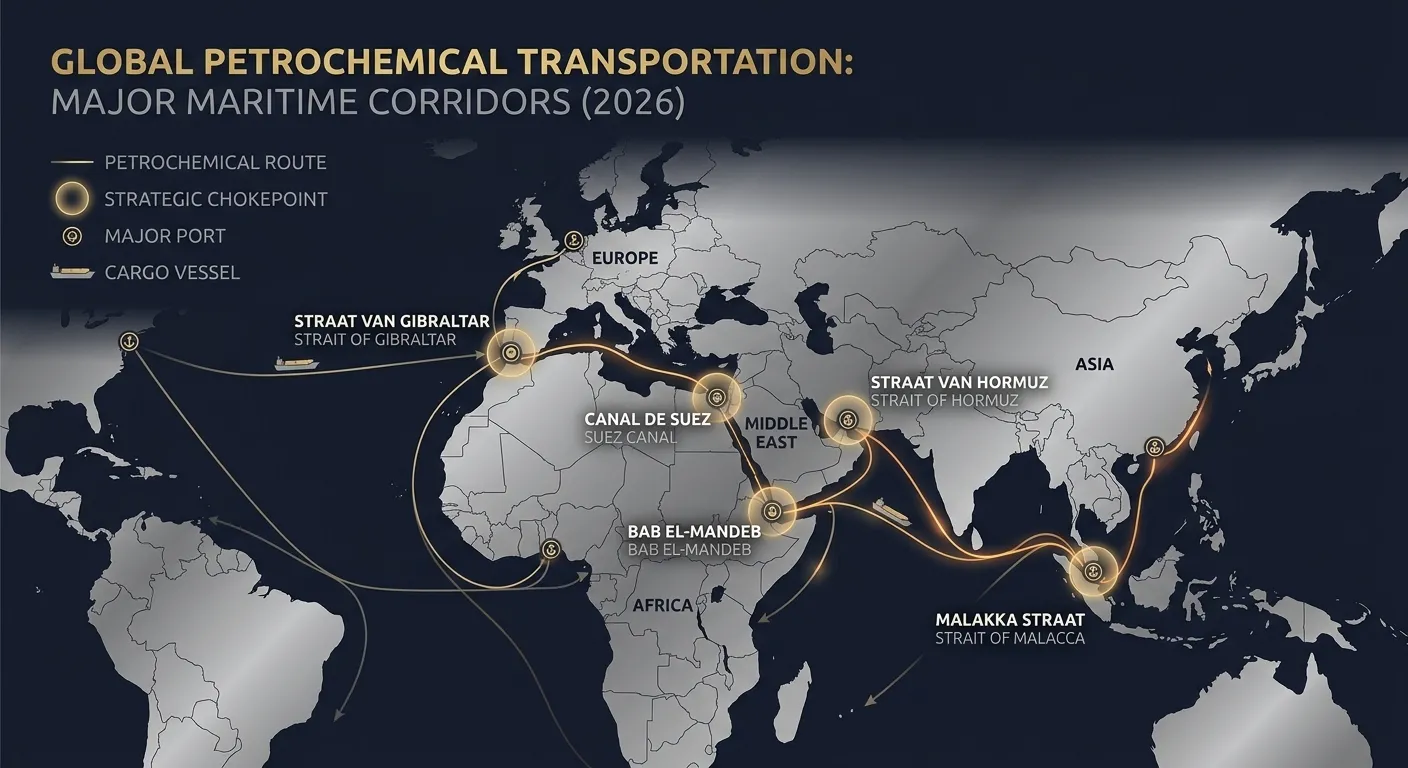
One of the most visible changes in 2026 has been the increased importance of major maritime chokepoints.
The Strait of Hormuz, the Red Sea and other strategic shipping corridors can influence the movement of energy commodities, petrochemicals, fertilizers and other industrial materials.
The IEA's Middle East Maritime Chokepoints Shipping Monitor has been tracking changes in maritime traffic through key regional routes. The agency also notes that AIS-based shipping data has limitations because some vessels have operated with their transponders switched off or under conditions affected by GPS interference.
For petrochemical buyers, the practical lesson is simple:
The shortest route is not always the most reliable route.
Depending on market conditions, an alternative port, multimodal transportation plan or different loading arrangement may provide a more workable solution.
Freight Costs Can Change the Economics of a Cargo
Transportation costs are particularly important for bulk and industrial commodities because the value of the cargo must be considered alongside its weight, volume and distance.
When freight rates increase, the difference between two suppliers can quickly disappear.
For example, a supplier offering a lower FOB price may not necessarily provide the lower landed cost if its cargo requires a longer or more expensive transportation route.
Recent reporting on Middle Eastern energy markets has also shown how disruptions around major shipping corridors can create significant freight pressure and encourage exporters and buyers to reconsider loading locations and transportation arrangements.
This makes freight analysis an increasingly important part of international petrochemical procurement.
Feedstock and Product Availability Are Closely Connected
Petrochemical production depends heavily on the availability and economics of feedstocks such as crude oil, natural gas, naphtha, LPG and other hydrocarbon streams.
When energy markets experience significant volatility, the impact can move through the chemical value chain.
A simplified supply chain can look like this:
Energy Feedstock → Petrochemical Production → Processing → Storage → Packaging → Transportation → International Trade → End User
A disruption at one stage can affect several stages that follow.
For buyers, this means that availability should not be evaluated only by asking whether a product exists in a supplier's warehouse. The buyer also needs to consider whether the material can be prepared, documented, loaded and transported within the required timeframe.
Inventory Management Is Becoming More Important
When transportation becomes less predictable, inventory planning becomes a strategic tool.
Companies that normally operate with minimal inventory may need to maintain additional safety stock for critical raw materials.
However, holding more inventory also creates costs.
Storage, financing, insurance, handling and the risk of price changes all have to be considered.
The right strategy therefore depends on the product, destination, consumption rate and reliability of the supply route.
For some buyers, a slightly higher-cost supply option with predictable delivery may be more practical than a cheaper option with significant uncertainty.
The Importance of Alternative Supply Routes
Supply-chain resilience does not necessarily mean finding one perfect route.
It often means having several workable options.
Depending on the product and destination, these options may include:
Alternative loading ports
Different inland transportation routes
Multimodal transportation
Additional storage locations
Alternative suppliers
Different packaging formats
Flexible delivery schedules
S&P Global has reported that Middle Eastern chemical markets have been adapting to shipping bottlenecks and that market participants have been evaluating alternative transportation and supply options.
For international buyers, flexibility can therefore become a competitive advantage.
What Should International Petrochemical Buyers Watch in 2026?
When evaluating a petrochemical purchase, buyers should look beyond the quoted product price.
Important questions include:
1. What is the exact product specification?
Products with the same commercial name can have different specifications.
Parameters such as purity, viscosity, moisture, density, mesh size, flash point or other technical characteristics may determine whether a product is suitable for a specific application.
2. Where is the cargo actually available?
The location of the product can have a major effect on the final logistics cost.
A product available close to a suitable export terminal may have a different landed cost from an otherwise identical product located far inland.
3. What packaging is required?
Packaging can affect handling, storage and transportation.
Depending on the product, buyers may require bulk delivery, drums, bags, jumbo bags, IBCs or other industrial packaging formats.
Our article Packaging Options for Petroleum, Petrochemical & Industrial Products provides a more detailed overview of the main options.
4. Which transportation route will be used?
The proposed route should be evaluated based on transit time, cost, border requirements, available capacity and current market conditions.
5. What is the total landed cost?
Comparing only FOB prices can lead to an incomplete purchasing decision.
Buyers should calculate the expected total cost of receiving the material at its final destination.
6. Can the supplier provide the required documentation?
Depending on the transaction, buyers may require:
Commercial Invoice
Packing List
Certificate of Origin
Certificate of Analysis
Safety Data Sheet
Inspection documents
Transport documents
Customs documentation
Documentation requirements can vary according to the product, destination and transaction structure.

Why Product Specifications Still Matter More Than Price
In volatile markets, buyers may be tempted to focus heavily on price.
However, purchasing an unsuitable product at a lower price can create significantly higher costs later.
Quality problems may result in rejected cargo, production interruptions, additional testing, repackaging or even the need to replace the material.
This is particularly important when purchasing industrial chemicals, polymers, solvents, minerals and other technical materials.
A professional purchasing process should therefore begin with a clear product specification and then compare suppliers based on both commercial and technical suitability.
Our guide on How to Choose a Reliable Iranian Supplier for Petroleum & Petrochemical Products covers several of the key factors buyers should consider when evaluating suppliers.
The Role of International Trading and Logistics Partners
As supply chains become more complicated, international trading partners can play a broader role than simply connecting a buyer with a producer.
Depending on the transaction, a trading and logistics partner may coordinate several stages of the process:
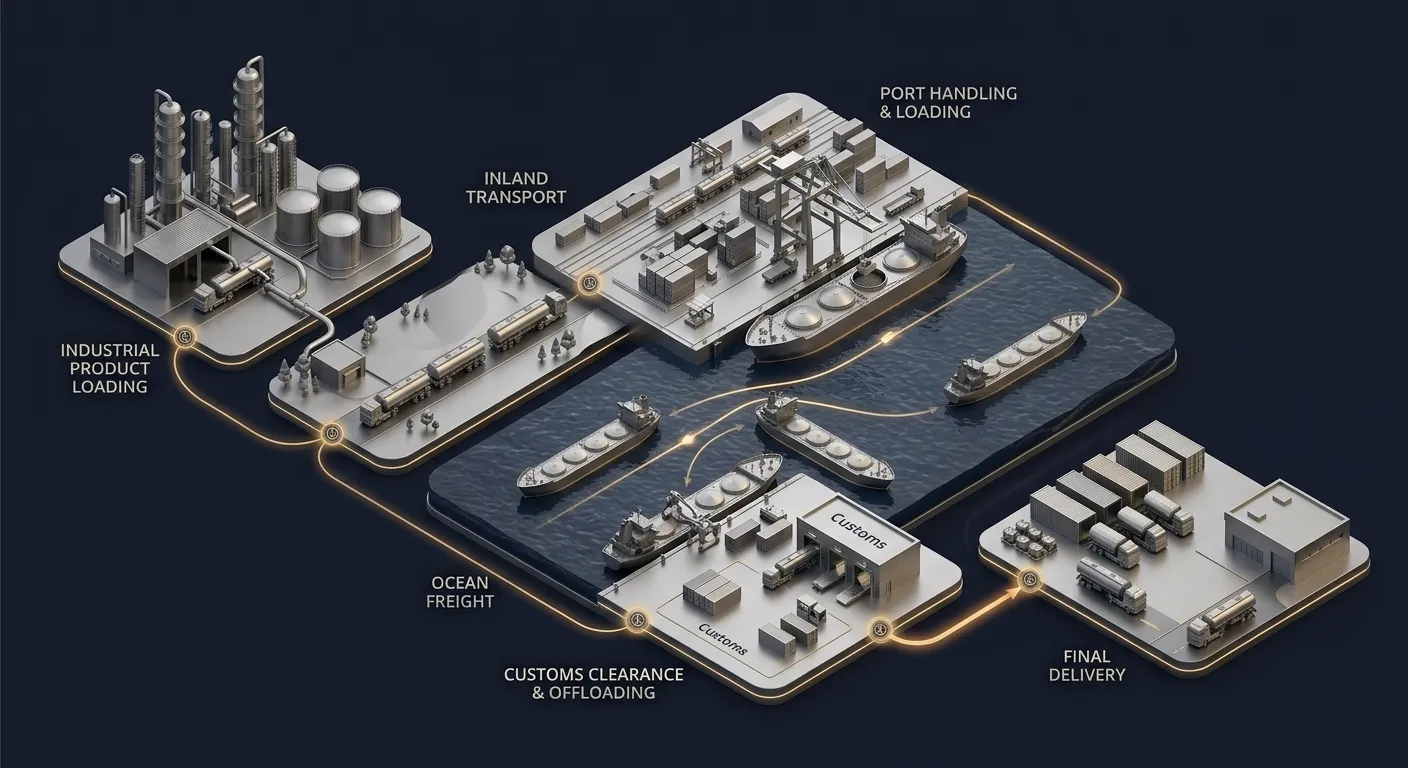
Product Sourcing → Specification Verification → Commercial Negotiation → Packaging → Documentation → Transportation → Customs Coordination → Final Delivery
This integrated approach can be particularly useful when buyers are purchasing from unfamiliar markets or when the most practical supply route involves multiple transportation stages.
For companies operating across different regional markets, the ability to coordinate sourcing, trading and logistics can help simplify communication and reduce unnecessary friction between different parts of the supply chain.
This is increasingly relevant for petrochemical and industrial products where the physical movement of cargo can be just as important as the commercial transaction itself.
Cross-Border Transportation Requires Flexibility
International transportation is rarely a fixed process.
Routes can change because of freight availability, border conditions, port capacity, weather, insurance requirements or changes in market conditions.
For this reason, cross-border logistics should be planned with a degree of flexibility.
Depending on the origin and destination, road, rail, sea or multimodal transportation may each have a role in the final delivery plan.
Our article Cross-Border Transportation of Petroleum & Industrial Products from Iran discusses some of the practical considerations involved in moving industrial cargo across borders.
From Product Inquiry to Final Delivery
A successful petrochemical transaction involves more than receiving a quotation.
A typical process can include:
1. Product Inquiry
The buyer provides the required product, quantity, specification and destination.
2. Specification Review
The supplier or trading partner confirms whether the requested specification can be supplied.
3. Commercial Offer
Price, quantity, packaging, Incoterm and payment conditions are discussed.
4. Logistics Planning
The transportation route, loading point and expected transit time are evaluated.
5. Documentation
Required commercial, technical and transportation documents are prepared.
6. Loading and Transportation
The cargo is prepared, loaded and dispatched.
7. Border or Port Procedures
Customs, inspection and handling requirements are completed.
8. Final Delivery
The cargo reaches the buyer or agreed destination.
This process highlights an important point: the supply chain is part of the product transaction.
What Does Supply Chain Resilience Mean for Petrochemical Buyers?
Resilience does not mean eliminating every possible risk.
Instead, it means building enough flexibility into the supply chain to respond when conditions change.
For buyers, this can involve:
Maintaining multiple sourcing options
Understanding alternative transportation routes
Monitoring freight markets
Verifying specifications before purchase
Maintaining appropriate inventory levels
Preparing complete documentation
Evaluating total landed cost
Working with experienced logistics and trading partners
KPMG's 2026 survey of oil, gas and chemicals companies found that supply-chain resilience and transformation are major priorities, with geopolitical uncertainty, operational efficiency and digitalization among the key drivers of supply-chain transformation.
The Outlook for the Rest of 2026
The petrochemical industry is likely to remain highly sensitive to transportation conditions, energy prices, trade flows and demand.
S&P Global's September 2026 market assessment describes the recovery in petrochemical markets as uneven, with elevated freight costs, inventory rebuilding, disrupted trade routes and uncertain demand continuing to influence the outlook.
At the same time, broader chemical-industry analysis points to persistent overcapacity and soft demand in some segments, making cost control and supply-chain flexibility increasingly important.
For international buyers, the implication is not necessarily that supply will become unavailable.
Rather, the process of finding, evaluating and delivering the right product may require more detailed planning than before.
Conclusion
Petrochemical supply chains are becoming more complex in 2026.
Changes in shipping routes, freight costs, feedstock markets, inventory strategies and international trade are changing the way buyers evaluate supply opportunities.
For international procurement teams, the most important shift may be moving away from a simple "price per metric ton" approach toward a broader assessment of:
Product + Specification + Packaging + Logistics + Risk + Landed Cost
In an increasingly interconnected market, reliable supply is not only about where a product is produced. It is also about how efficiently and predictably that product can reach its final destination.
For buyers and trading partners alike, flexibility, accurate information and coordinated logistics are becoming increasingly important parts of international petrochemical trade.
Frequently Asked Questions
What is a petrochemical supply chain?
A petrochemical supply chain covers the movement of raw materials and petrochemical products from feedstock and production through processing, storage, packaging, transportation, trading and final delivery.
Why are petrochemical supply chains under pressure in 2026?
Several factors are contributing to supply-chain pressure, including shipping disruptions, higher freight costs, feedstock volatility, uneven demand, geopolitical uncertainty and changes in international trade routes.
How do freight costs affect petrochemical prices?
Freight is part of the total landed cost of a product. A significant increase in transportation costs can make a previously competitive supply option less attractive, even when the product price itself remains unchanged.
What is supply-chain resilience?
Supply-chain resilience refers to the ability of a supply network to continue operating and adapt when disruptions affect suppliers, transportation routes, inventories or other critical stages.
Why is landed cost important when buying petrochemical products?
Landed cost provides a more complete picture of the actual purchasing expense because it can include product price, packaging, inland transportation, freight, insurance, customs and other delivery-related costs.
What should buyers verify before purchasing petrochemical products?
Buyers should verify the product specification, quantity, origin, packaging, availability, documentation, loading point, transportation route, Incoterm, payment conditions and expected landed cost.
How can international trading partners help petrochemical buyers?
Depending on the transaction, an experienced trading partner can help coordinate product sourcing, specification review, commercial negotiations, packaging, documentation, transportation and final delivery.