
Solvents are essential raw materials across a wide range of industrial sectors, including paints and coatings, adhesives, plastics, chemicals, pharmaceuticals, cleaning products, and manufacturing.
For international buyers, sourcing solvents from Iran can provide access to a broad petrochemical supply base and competitive regional logistics. However, successful solvent procurement requires careful attention to product specification, purity, packaging, origin, transportation, and commercial terms.
For buyers evaluating solvent supply from Iran, understanding the product requirements and export process is essential before requesting a quotation or placing an order.
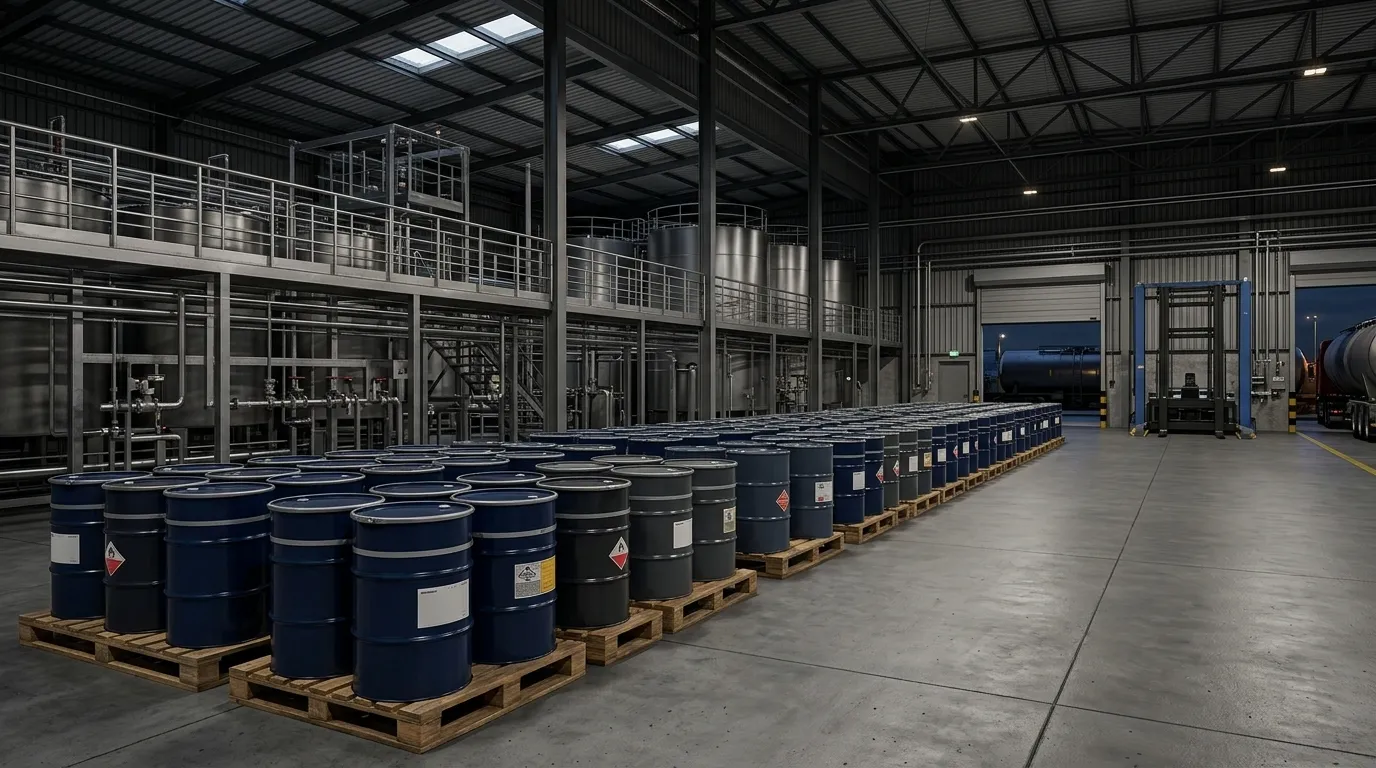
What Are Industrial Solvents?
Industrial solvents are substances capable of dissolving, dispersing, or extracting other materials. They are widely used in manufacturing processes where a controlled solvent is required for formulation, cleaning, extraction, dilution, or chemical processing.
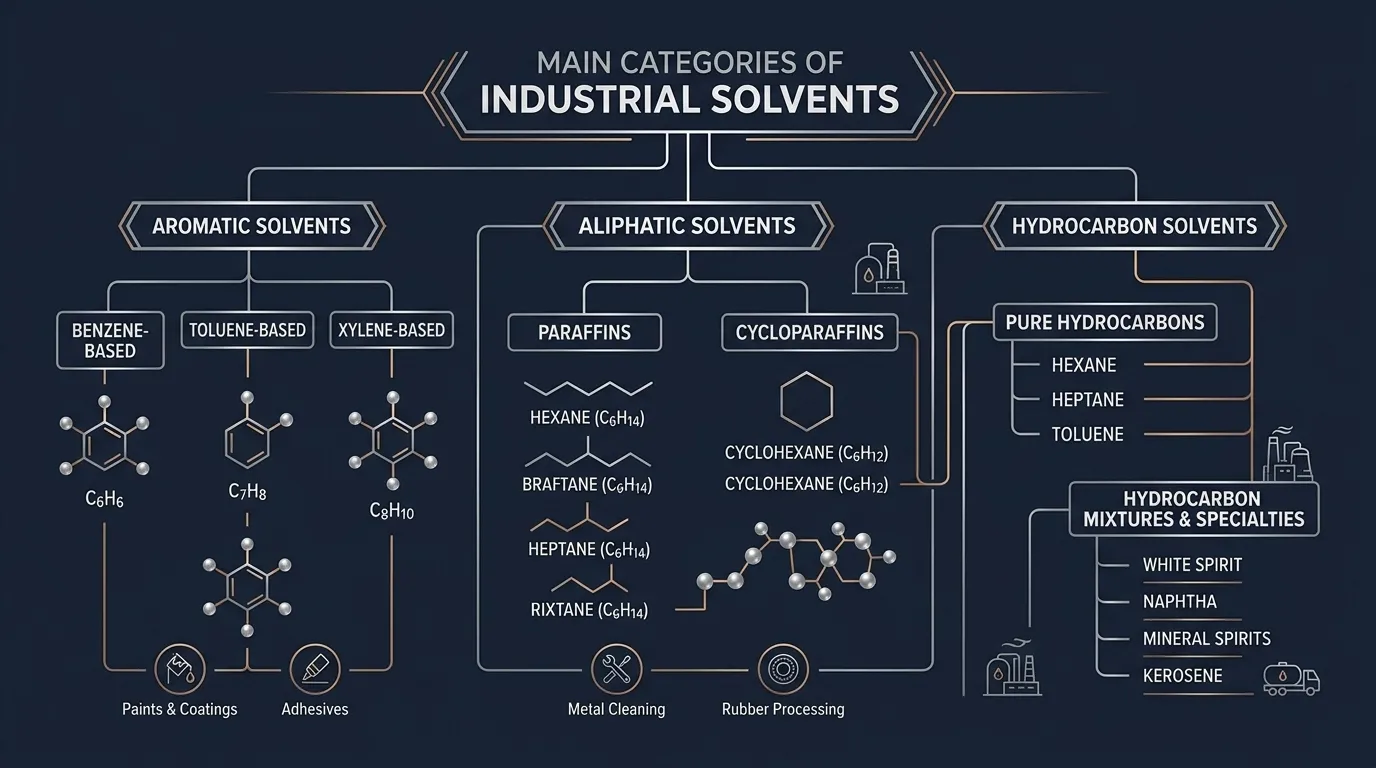
Solvents can be broadly classified according to their chemical composition and industrial properties.
Depending on the application, buyers may require specific characteristics such as:
- Purity
- Boiling range
- Density
- Flash point
- Aromatic content
- Water content
- Color
- Distillation range
- Chemical composition
- Residue after evaporation
The required specification depends heavily on the intended application and production process.
For international buyers who are new to sourcing petrochemical products from Iran, our guide on How to Buy Petroleum & Petrochemical Products from Iran provides an overview of the sourcing process, specifications, supplier communication, and international delivery considerations.
Common Types of Solvents
The term "solvent" covers a broad range of products. The exact product required by a buyer depends on the intended industrial application.
Common categories include:
Aromatic Solvents
Aromatic solvents are used in applications such as paints, coatings, adhesives, printing inks, and chemical manufacturing.
Depending on the product and specification, aromatic solvents may include materials based on compounds such as toluene and xylene.
Aliphatic Solvents
Aliphatic solvents are commonly used in paints, coatings, cleaning products, degreasing, and industrial formulations.
Their physical and chemical characteristics can vary considerably depending on the hydrocarbon composition.
Hydrocarbon Solvents
Hydrocarbon solvents are widely used in industrial manufacturing, cleaning, extraction, coatings, and other applications.
The required boiling range and composition should be confirmed before purchase.
Specialized Solvents
Certain industrial processes require solvents with more specific chemical or physical properties.
For these products, buyers should provide a complete technical specification rather than relying only on a commercial product name.
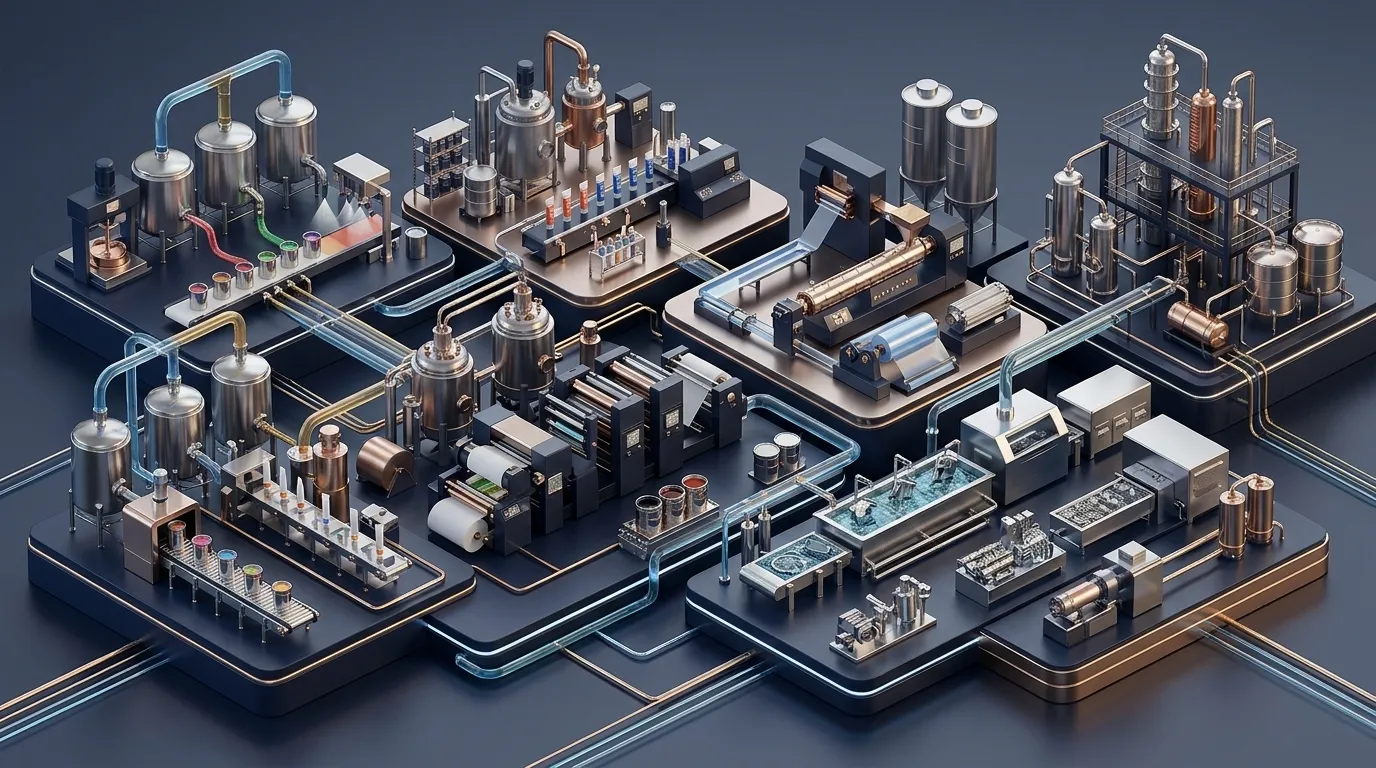
Major Applications of Industrial Solvents
Solvents are used across many industries.
Paints and Coatings
Solvents help dissolve or disperse resins and other components in paints and coatings and can influence viscosity, drying characteristics, and application performance.
Different coating systems require different solvent properties.
Adhesives
Solvents are used in the formulation of many adhesive products.
The correct solvent can influence viscosity, evaporation rate, compatibility, and final product performance.
Chemical Manufacturing
Solvents can serve as reaction media, extraction agents, cleaning agents, or processing aids in chemical manufacturing.
Plastics and Polymer Processing
Certain solvents are used during polymer processing and in the production of plastics, synthetic materials, and related products.
Cleaning and Degreasing
Industrial solvents are also used for removing oils, grease, residues, and contaminants from machinery, equipment, and manufactured components.
Printing Inks
Solvents play an important role in the formulation and application of many printing inks, where evaporation characteristics and compatibility with other ingredients are important.
Why Solvent Specification Matters
One of the most important considerations when purchasing solvents internationally is the product specification.
A buyer requesting only "industrial solvent" may receive offers for products with significantly different properties.
Before requesting a quotation, buyers should ideally provide:
- Exact product name or grade
- Technical specification
- Required purity
- Intended application
- Required quantity
- Packaging requirement
- Destination
- Preferred Incoterm
- Required delivery schedule
Depending on the product, the buyer may also need to specify parameters such as boiling range, density, flash point, aromatic content, water content, or other technical characteristics.
Providing a complete specification allows suppliers and trading companies to identify a suitable product and reduces the risk of supplying a material that does not meet the buyer's production requirements.
Solvent Packaging Options
Packaging is another important consideration in international solvent shipments.
The appropriate packaging depends on the physical characteristics of the product, quantity, transportation method, storage requirements, and buyer's facilities.
Possible packaging and transportation formats may include:
- Steel drums
- Plastic drums where technically appropriate
- Industrial cans
- IBC containers
- Flexitanks for suitable products
- Bulk tanker transportation
Not every solvent is suitable for every packaging format. Compatibility, safety requirements, handling procedures, and transportation regulations should be evaluated before shipment.
For a broader overview of industrial packaging methods, see Packaging Options for Petroleum, Petrochemical & Industrial Products.
Packaging specifications should be agreed before the final commercial offer because they can affect both handling requirements and transportation costs.
Solvent Supply from Iran
Iran has an established petrochemical and hydrocarbon processing sector, providing access to various petroleum-derived and chemical products.
For international buyers, sourcing solvents from Iran may involve coordination between producers, traders, logistics providers, customs operations, and international freight companies.
A typical supply process may include:
- Product identification
- Supplier sourcing
- Technical specification review
- Availability confirmation
- Price quotation
- Packaging confirmation
- Quality documentation
- Loading arrangements
- Inland transportation
- Export procedures
- International transportation
- Final delivery
The exact process depends on the product, origin, destination, quantity, and commercial agreement.
Export Considerations for Solvents
International solvent shipments require more attention to logistics and documentation than many conventional industrial products.
Depending on the specific solvent, buyers and suppliers may need to consider:
- Product classification
- Safety Data Sheet (SDS)
- Certificate of Analysis (COA)
- Packaging requirements
- Labeling
- Loading procedures
- Transportation regulations
- Customs documentation
- Port handling
- International freight
- Insurance where applicable
Certain solvents may also be classified as hazardous materials for transportation purposes depending on their physical and chemical properties.
Therefore, the exact product specification should be established before transportation arrangements are finalized.

Choosing the Right Incoterm
The selected Incoterm determines how responsibilities, costs, and certain risks are allocated between the buyer and seller.
For example, under FOB, the buyer generally takes responsibility for the main international transportation after the agreed handover point, while CFR and CIF involve freight arrangements by the seller.
Buyers comparing different offers should therefore avoid comparing only the quoted product price.
For a detailed explanation of these commercial terms, see FOB vs. CFR vs. CIF: Understanding Incoterms for International Buyers.
The final comparison should consider product price, freight, insurance where applicable, inland transportation, handling costs, and other charges that contribute to the landed cost.
What International Buyers Should Verify Before Purchasing Solvents
Before confirming a solvent order, buyers should review several important factors.
1. Product Identity
Confirm the exact commercial and technical identity of the solvent.
2. Technical Specification
Review the specification and confirm that the offered material meets the intended application.
3. Certificate of Analysis
Where applicable, request the relevant COA or quality documentation.
4. Safety Data Sheet
For products requiring specific handling or transportation procedures, review the applicable SDS.
5. Origin
Confirm the product origin and, where relevant, the producing facility.
6. Quantity
Verify available stock or production capacity against the required shipment volume.
7. Packaging
Confirm the packaging type, unit size, loading configuration, and handling requirements.
8. Destination
Provide the destination port, terminal, or delivery location as early as possible.
9. Incoterm
Clearly define whether the offer is EXW, FOB, CFR, CIF, or another agreed term.
10. Delivery Schedule
Confirm the expected preparation, loading, transit, and delivery timeline.
Choosing a Reliable Iranian Solvent Supplier
Price is only one part of an international solvent transaction.
Buyers should also consider the supplier's ability to provide consistent product quality, documentation, packaging, and logistics coordination.
Important factors include:
- Product consistency
- Technical documentation
- Availability
- Packaging capability
- Loading capacity
- Export experience
- Communication
- Logistics coordination
- Delivery capability
A supplier that offers a competitive price but cannot reliably provide documentation or coordinate shipment may create additional costs and delays.
For a broader guide to evaluating Iranian suppliers, see How to Choose a Reliable Iranian Supplier for Petroleum & Petrochemical Products.
Solvent Transportation and International Logistics
Transportation planning is particularly important for solvent shipments because the physical properties of the product can influence packaging, vehicle selection, handling procedures, and shipping requirements.
Depending on the cargo and destination, logistics may involve:
- Road transportation
- Containerized transportation
- Tanker transportation
- Port handling
- International sea freight
- Customs clearance
- Final-mile delivery
The transportation method should be selected according to the product characteristics, quantity, packaging, destination, and applicable transportation requirements.
For a broader look at international movement of petroleum and industrial cargo, see Cross-Border Transportation of Petroleum & Industrial Products from Iran.
Solvent Supply Through an International Trading Partner
International buyers do not always purchase solvents directly from the producing facility.
A trading and supply partner can coordinate different stages of the transaction, including product sourcing, supplier communication, technical documentation, packaging, inland transportation, export procedures, and international logistics.
This can be useful for buyers who require a coordinated supply chain rather than purchasing the product alone.
At TAV PETROIL, solvent requirements can be evaluated according to the buyer's required specification, quantity, destination, packaging, and delivery terms.
Buyers are encouraged to provide the exact product requirement and technical specification when requesting a quotation. This allows available supply options to be evaluated against the buyer's actual application and delivery requirements.
From Solvent Inquiry to Final Delivery
A typical international solvent procurement process can follow several stages.
1. Product Inquiry
The buyer provides the required solvent, specification, quantity, packaging, and destination.
2. Product and Supplier Verification
Available supply is reviewed against the buyer's technical requirements.
3. Commercial Offer
Price, packaging, Incoterm, payment conditions, and delivery arrangements are discussed.
4. Documentation Review
Relevant technical and commercial documents are reviewed before shipment.
5. Packaging and Loading
The cargo is prepared and loaded according to the agreed requirements.
6. Transportation and Export Logistics
Inland transportation, customs procedures, port operations, and international freight are coordinated.
7. Final Delivery
The cargo is delivered to the agreed destination or handover point.
This structured approach helps both buyers and suppliers establish clear expectations before the shipment begins.
Why Buyers Should Compare Landed Cost, Not Only Product Price
A lower quoted solvent price does not necessarily result in a lower overall procurement cost.
International buyers should consider:
- Product price
- Product specification
- Packaging
- Inland transportation
- Port charges
- Freight
- Insurance where applicable
- Customs and documentation
- Handling costs
- Delivery time
- Payment conditions
The landed cost provides a more useful basis for comparing international supply options than the initial product price alone.
This is particularly important when comparing suppliers from different origins or when transportation requirements differ significantly between offers.
Conclusion
Industrial solvents are essential inputs for numerous manufacturing and chemical processes, and their specifications can vary significantly depending on the intended application.
For buyers considering solvent supply from Iran, the procurement process should begin with a clear product specification. Purity, physical properties, packaging, documentation, origin, destination, Incoterms, and transportation requirements should all be established before comparing commercial offers.
A properly coordinated supply chain can help international buyers manage the process from product sourcing and packaging through export logistics and final delivery.
TAV PETROIL supports international buyers with sourcing, packaging coordination, transportation, and export logistics for petroleum and petrochemical products. Buyers looking for solvents from Iran can provide their required product specification, quantity, destination, and preferred delivery terms for further evaluation.
Frequently Asked Questions
What types of solvents can be sourced from Iran?
Available products depend on current producer availability and the buyer's required specification. Solvent categories may include aromatic, aliphatic, and other hydrocarbon-based industrial solvents.
What information should I provide when requesting a solvent quotation?
Buyers should ideally provide the exact product name or grade, technical specification, required quantity, packaging, destination, and preferred Incoterm.
Can solvents from Iran be exported internationally?
Yes. Solvents are internationally traded products, although the applicable transportation, packaging, documentation, and handling requirements depend on the specific product.
What documents may be required for solvent shipments?
Depending on the product and destination, documentation may include a Certificate of Analysis, Safety Data Sheet, commercial invoice, packing list, certificate of origin, and other export or transportation documents.
What packaging options are available for solvents?
Depending on the product, quantity, and transportation requirements, solvents may be supplied in drums, IBCs, containers, flexitanks, or bulk transportation systems where technically appropriate.
How should I compare solvent offers from different suppliers?
Compare the complete landed cost rather than only the product price. Product specification, packaging, freight, inland transportation, documentation, delivery time, and Incoterms should all be considered.
Can TAV PETROIL arrange transportation for solvent shipments?
TAV PETROIL can coordinate transportation and export logistics according to the product, quantity, destination, packaging, and agreed delivery terms.