
For international buyers, sourcing petroleum and petrochemical products from Iran can involve more than simply finding a competitive price.
A successful transaction requires coordination between product specifications, supplier capability, documentation, packaging, transportation, payment terms, delivery conditions, and the final destination.
This is why choosing the right supplier should be treated as a structured commercial evaluation rather than a simple price comparison.
In this guide, we explain the key factors international buyers should consider when evaluating an Iranian supplier for petroleum, petrochemical, and industrial products.
1. Start With the Exact Product Specification
The first step is to clearly define what you need.
A product name alone is often not enough.
For example, a buyer looking for base oil should specify the required grade and technical parameters. Similarly, a buyer sourcing bitumen, solvents, PVC, urea, or industrial minerals should provide the relevant technical specification or analysis.
Depending on the product, an RFQ may include:
Product name
Grade
Technical specification
Required analysis
Quantity
Packaging
Origin requirements
Destination
Delivery schedule
Preferred Incoterm
A clear specification allows suppliers to determine whether they can actually provide the required material instead of simply offering a similar product.
2. Ask for the Product Analysis
One of the most important steps in international sourcing is comparing the actual product analysis with the buyer's requirements.
Different producers or production facilities can offer different specifications for products that have the same commercial name.
For this reason, buyers should request relevant technical documentation before making a purchasing decision.
Depending on the product, this may include:
Certificate of Analysis (COA)
Technical Data Sheet (TDS)
Safety Data Sheet (SDS), where applicable
Product specification
Origin information
Batch or production information, where applicable
The goal is not simply to confirm the product name, but to verify that the material matches the buyer's technical requirements.

3. Verify the Supplier's Actual Supply Capability
A supplier's ability to quote a product does not necessarily mean that the supplier can consistently deliver it.
Buyers should ask practical questions such as:
Where is the product sourced?
Who is the producer?
What quantity is currently available?
What is the regular supply capacity?
Can the supplier handle repeat orders?
What is the expected preparation time?
Where will the cargo be loaded?
What transportation options are available?
For larger transactions, understanding the supply chain behind the quotation becomes particularly important.
A reliable sourcing process should connect the product, supplier, quantity, logistics, and destination rather than treating each element separately.
4. Check Packaging Requirements
Packaging can have a direct effect on handling and transportation.
Depending on the product, packaging may include:
Bags
Jumbo bags / Big Bags
Drums
Pallets
Bulk solutions
Other product-specific packaging
The buyer should specify the required packaging at the quotation stage.
This is particularly important for industrial minerals, polymers, fertilizers, chemicals, and other products that may be transported in significant quantities.
TAV PETROIL coordinates packaging and handling requirements according to the product, quantity, transportation conditions, destination, and customer specifications.
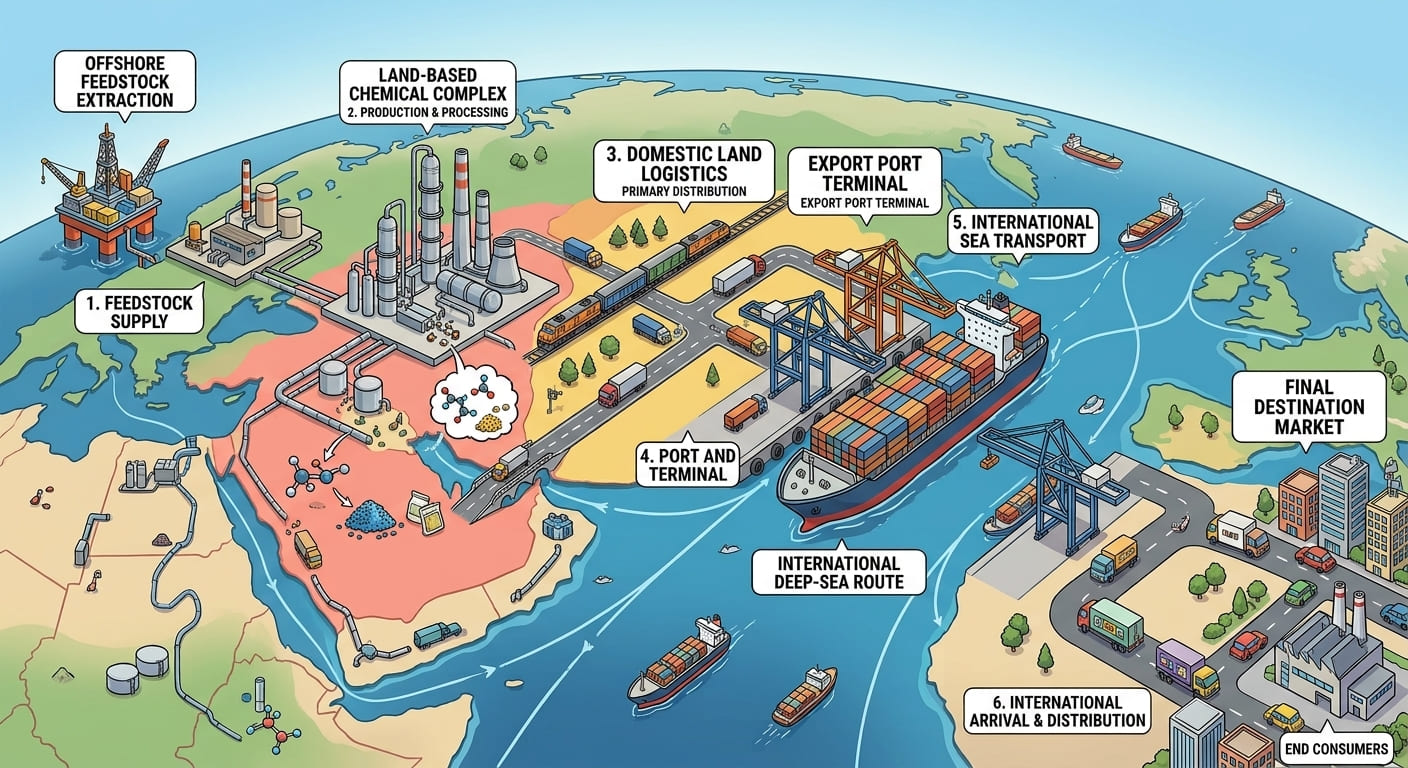
5. Evaluate the Logistics Plan
A supplier may have the right product at the right price, but the transaction still depends on a workable logistics plan.
International buyers should understand:
Where is the cargo located?
How will it move from origin to destination?
Which transport mode will be used?
Who coordinates loading and transportation?
What is the expected delivery schedule?
These questions become especially important when the shipment involves multiple stages or cross-border transportation.
TAV PETROIL coordinates sourcing, packaging, documentation, transportation, shipment planning, and delivery as part of its broader energy logistics service.
6. Understand the Incoterm
The Incoterm in a quotation is not just a pricing abbreviation.
Incoterms® 2020 define important responsibilities between buyers and sellers, including delivery, allocation of certain costs, and transfer of risk.
Common terms used in international trade include:
EXW
FCA
FOB
CFR
CIF
CPT
CIP
DAP
DPU
DDP
The appropriate term depends on the actual transportation structure.
For example, a quotation of FOB, CFR, or CIF should not be compared directly with an EXW quotation without considering what transportation and other costs are included.
Buyers should always identify the named place or port and specify the applicable Incoterms® version in the commercial agreement.
For more information, see our guide to FOB vs. CFR vs. CIF.
7. Compare Total Landed Cost, Not Just Product Price
One of the most common mistakes in international sourcing is choosing the supplier with the lowest quoted product price.
Consider two offers:
Supplier A: Lower product price + higher freight
Supplier B: Higher product price + lower freight
The second offer may result in a lower overall cost depending on the shipment structure.
Buyers should therefore consider:
Product price
Packaging
Inland transportation
Export-related costs
International freight
Insurance, where applicable
Destination charges
Customs-related costs
Import duties and taxes
Final delivery
The relevant comparison is often the total landed cost, not simply the supplier's initial price per metric ton.
8. Clarify Payment Terms Before Moving Forward
Payment terms should be clearly discussed before a transaction is finalized.
Depending on the transaction and the parties involved, buyers may encounter different payment structures.
The commercial agreement should clearly establish:
Payment method
Payment timing
Currency
Required banking or financial arrangements
Conditions for payment
Required commercial documents
For international transactions involving multiple jurisdictions, buyers should also ensure that their proposed payment structure complies with all applicable laws and regulations.
9. Check Documentation
Documentation is an important part of international commodity trading.
Depending on the product and transaction, documentation may include:
Commercial Invoice
Packing List
Certificate of Origin
Certificate of Analysis
Bill of Lading or other transport document
Safety Data Sheet, where applicable
Inspection documents, if agreed
Other product- or destination-specific documents
The exact documentation package should be agreed between buyer and seller before shipment.
10. Look at Communication and Coordination
A supplier can have access to the right product but still create difficulties if communication is unclear.
During the negotiation stage, pay attention to whether the supplier can clearly answer questions about:
Product specification
Availability
Quantity
Packaging
Origin
Loading point
Delivery schedule
Incoterms
Documentation
Logistics
Clear communication is particularly important when several parties are involved in a shipment.
TAV PETROIL's supply model is built around coordination between buyers, suppliers, logistics providers, and other parties involved in the transaction.

11. Be Careful With Unrealistically Low Prices
A very low quotation may look attractive, but buyers should understand what is actually included.
Before comparing a price with other offers, confirm:
Is the specification identical?
Is the quantity identical?
Is the packaging identical?
Is the Incoterm identical?
Is the delivery destination identical?
Is freight included?
Are inspection or documentation costs included?
Is the quoted price still valid?
A price comparison only becomes meaningful when the commercial conditions are comparable.
12. Consider the Destination From the Beginning
The destination should be part of the sourcing discussion from the beginning.
For example, a buyer shipping to:
Jebel Ali
Karachi
China
Turkey
Central Asia
Europe
Africa
may require different logistics planning depending on the product, transportation route, and delivery conditions.
TAV PETROIL's supply process is structured around the customer's product, quantity, destination, packaging, and delivery requirements, allowing sourcing and logistics considerations to be reviewed together.
13. Ask the Supplier for a Complete Commercial Offer
Instead of asking only:
"What is your price?"
an international buyer can provide a complete RFQ.
For example:
Product: Calcium Carbonate
Specification: 450 Mesh
Quantity: 500 MT
Packaging: Jumbo Bags
Destination: Jebel Ali, UAE
Incoterm: CFR Jebel Ali
Required Documents: COA, COO, Packing List, Commercial Invoice
Delivery: Please advise earliest available schedule
This gives the supplier enough information to prepare a more meaningful commercial offer.
A Practical Supplier Evaluation Checklist
Before proceeding with an Iranian supplier, buyers can review the following:
Product
Exact product specification confirmed
Required grade confirmed
Product analysis reviewed
Origin clarified
Commercial
Quantity confirmed
Price basis confirmed
Incoterm confirmed
Payment terms discussed
Offer validity confirmed
Packaging
Packaging type confirmed
Unit weight confirmed
Labeling requirements confirmed
Loading method discussed
Logistics
Loading location confirmed
Transportation method identified
Destination confirmed
Delivery schedule discussed
Freight costs understood
Documentation
COA
TDS/SDS where applicable
Certificate of Origin
Commercial Invoice
Packing List
Transport documents
Additional destination-specific documents
How TAV PETROIL Approaches International Supply
TAV PETROIL works with international buyers to coordinate sourcing and supply requirements for petroleum, petrochemical, energy, and industrial products.
Our supply process can involve:
Requirement → Product Matching → Supplier Coordination → Commercial Offer → Packaging → Documentation → Transportation → Delivery
Our Oil & Petrochemical Supply service covers sourcing and supply coordination for products including base oils, solvents, bitumen, diesel, gasoline, PVC, urea, and other oil, petrochemical, and industrial products.
Packaging requirements can be coordinated through Packaging & Handling, while transportation and broader cross-border requirements can be incorporated into the Energy Logistics process.
The objective is to connect the commercial side of sourcing with the practical requirements of moving the product to its destination.
What Should International Buyers Send to TAV PETROIL?
If you are looking for an Iranian supplier, providing the following information can help us evaluate your requirement more efficiently:
Product name
Required specification or analysis
Quantity
Packaging
Destination country and port
Preferred Incoterm
Required delivery schedule
Required documentation
If you already have a target specification or analysis, include it with your inquiry.
This is particularly useful because different regional producers may offer different product analyses under similar commercial product names.
Final Thoughts
Choosing a reliable Iranian supplier should not be based on price alone.
A professional sourcing process should consider the complete transaction:
Product + Specification + Supplier Capability + Packaging + Documentation + Logistics + Incoterms + Delivery
When these elements are reviewed together, buyers can make clearer comparisons between suppliers and reduce the risk of misunderstandings during the transaction.
For international buyers looking for petroleum, petrochemical, or industrial products from Iran, TAV PETROIL can coordinate sourcing, commercial requirements, packaging, transportation, and delivery according to the specific shipment.
Contact TAV PETROIL with your product specification, quantity, and destination to discuss your requirement.
Frequently Asked Questions
How can I verify an Iranian petroleum supplier?
Start by checking the supplier's product specifications, available documentation, supply capability, commercial terms, logistics arrangements, and ability to answer technical and commercial questions clearly. For larger transactions, buyers should conduct appropriate independent due diligence and obtain any required verification or inspection.
What documents should I request from an Iranian supplier?
Depending on the product and transaction, buyers may request a Certificate of Analysis, Technical Data Sheet, Safety Data Sheet where applicable, Certificate of Origin, Commercial Invoice, Packing List, and transport documentation.
Should I ask for a Certificate of Analysis?
Yes. Where applicable, the COA is useful for comparing the offered material against the buyer's required specification. Buyers should review the actual parameters relevant to their application rather than relying only on the commercial product name.
How should I compare quotations from different Iranian suppliers?
Compare offers on an equivalent basis. Check product specification, quantity, packaging, Incoterm, destination, freight, documentation, payment terms, and delivery schedule before comparing the final price.
Is the cheapest Iranian supplier always the best option?
Price alone does not provide enough information to evaluate a supplier. A lower initial quotation may have different specifications, packaging, freight arrangements, payment terms, or delivery conditions.
Can TAV PETROIL source products according to a buyer's specification?
Yes. TAV PETROIL's supply process is based on the buyer's required product specifications, quantity, packaging, destination, and delivery expectations.
Can TAV PETROIL coordinate transportation as well as supply?
Yes. TAV PETROIL coordinates transportation, packaging, documentation, destination requirements, and delivery as part of its broader energy logistics approach.
What information should I include in an RFQ?
At minimum, provide the product, specification, quantity, packaging requirement, destination, preferred Incoterm, and expected delivery schedule. If you have a target analysis or technical specification, include it as well.
How can I contact TAV PETROIL?
You can submit your requirement through the TAV PETROIL Contact page or contact the team at info@tavpetroil.com. The company states that inquiries are generally answered within one business day.