
International trade in petroleum derivatives, petrochemicals, industrial chemicals, and polymers involves more than agreeing on a price and arranging transportation. Before a shipment reaches its destination, importers must identify the correct customs classification for the goods they are purchasing. This is where the Harmonized System (HS) code becomes essential. Customs authorities use HS-based product classifications to identify traded goods, administer tariffs, collect duties, and apply relevant import controls. An incorrect code can lead to customs queries, shipment delays, additional costs, or penalties, depending on the destination country's rules and the circumstances of the declaration. For companies sourcing industrial materials across international markets, understanding HS codes for petrochemical products is an important part of procurement planning, documentation, and logistics coordination.
This guide explains how HS codes work, which product categories importers commonly encounter, how to verify a classification, and what to check before shipping a petrochemical cargo.
What Is an HS Code?
The Harmonized Commodity Description and Coding System, commonly known as the Harmonized System or HS, is an international nomenclature developed and maintained by the World Customs Organization (WCO). The system organizes traded goods into categories using numerical codes. The first six digits form the internationally harmonized level, while individual countries can add further digits to create more detailed national tariff classifications. For example, a product may have a six-digit HS subheading used internationally, followed by additional digits in the importing country's tariff schedule. Those additional digits can determine the applicable duty rate, statistical reporting requirements, or other national measures. The exact code must therefore be checked against the tariff schedule applicable in the country of import.
Importers can consult the World Customs Organization's HS resources and the World Trade Organization's explanation of HS six-digit codes as starting points.
Why HS Codes Matter in Petrochemical Trade
Correct customs classification affects several parts of an international transaction.
1. Customs Duties and Taxes
The declared classification is one of the factors used to determine customs duties and other import charges. Two products that appear commercially similar may be treated differently under a country's tariff schedule. Importers should not calculate the landed cost of a product using an assumed HS code or a code copied from an unrelated shipment.
2. Import Permits and Regulatory Requirements
Certain chemicals and petroleum-related products may be subject to licensing, safety, environmental, quality, or other regulatory requirements. Classification can help authorities identify which measures may apply, although the code alone does not establish that every requirement has been satisfied.
3. Customs Clearance and Shipment Planning
An inconsistent description or classification may trigger additional questions from customs authorities. If the commercial invoice, packing list, technical documentation, and declaration describe the product differently, the importer may need to provide clarification or amend documents.
4. Accurate Landed-Cost Calculations
Importers need a realistic view of total delivered cost before confirming a purchase. Customs duties, taxes, inspection expenses, storage, and possible clearance delays can affect the economics of a transaction. For a broader view of the commercial and operational factors affecting international trade, read TAV PETROIL's article on petrochemical supply chains under pressure in 2026.
Which HS Chapters Are Relevant to Petrochemical Products?
Petrochemical-related goods do not all fall under one chapter. Classification depends on the product's composition, properties, processing, and the applicable legal notes. The following chapters and headings are useful starting points, not a substitute for product-specific classification.
Chapter 27: Mineral Fuels, Petroleum Oils, and Related Products
Chapter 27 covers mineral fuels, mineral oils and products of their distillation, bituminous substances, and mineral waxes. Depending on the precise product and its characteristics, this chapter may be relevant to petroleum oils, certain fuel products, liquefied petroleum gases, and petroleum bitumen. For example, petroleum bitumen is commonly associated with heading 2713, while certain petroleum oils and preparations are classified under heading 2710. These are broad headings; the appropriate subheading depends on the product's actual characteristics and the destination country's tariff structure. Importers should pay particular attention to distinctions between crude and refined products, individual petroleum fractions, preparations, and materials that may be classified elsewhere.
Chapter 29: Organic Chemicals
Chapter 29 covers many separately chemically defined organic compounds, subject to the chapter's legal notes and exceptions.
Some petrochemical feedstocks and chemical intermediates may be classified in this chapter. Examples of relevant headings include:
2901: Acyclic hydrocarbons.
2902: Cyclic hydrocarbons.
2905: Acyclic alcohols and certain related derivatives.
For instance, methanol is generally classified under heading 2905.11 at the international HS six-digit level, while benzene is generally classified under 2902.20. However, a commercial name is not enough to confirm a classification. The importer should verify the product's chemical identity, purity, composition, and applicable classification notes.

Chapter 31: Fertilizers
Some products associated with petrochemical production are traded as fertilizers and may be classified under Chapter 31. Urea, for example, is generally associated with HS subheading 3102.10 when it meets the relevant classification criteria. Its intended use, composition, and applicable legal provisions should still be checked. Do not assume that a product belongs in a particular chapter simply because it is produced by a petrochemical complex. Customs classification follows the nomenclature and legal rules, not only the industry's commercial terminology.
Chapter 39: Plastics and Articles Thereof
Chapter 39 covers plastics and articles thereof. Several widely traded polymer resins fall within this chapter.
Common international HS heading examples include:
3901: Polymers of ethylene in primary forms, including many polyethylene products.
3902: Polymers of propylene or of other olefins in primary forms, including polypropylene.
3904: Polymers of vinyl chloride or other halogenated olefins in primary forms, including many PVC resin products.
These headings are useful for initial research, but the exact subheading may depend on the polymer type, composition, physical form, and other classification criteria. For PVC and other polymer purchases, buyers should verify the grade and technical specification rather than relying on the product name alone.
Common HS Code Examples for Petrochemical and Related Products
The table below provides examples of international HS headings or six-digit subheadings that can help importers begin their research.
| Product | Common HS reference | What to verify |
|---|---|---|
| Certain petroleum oils and preparations | 2710 | Product composition, use, and relevant subheading criteria |
| Petroleum bitumen | 2713.20 | Product identity and applicable national tariff line |
| Methanol | 2905.11 | Chemical identity and purity |
| Benzene | 2902.20 | Chemical identity and composition |
| Polyethylene in primary forms | 3901 | Polymer type and relevant subheading |
| Polypropylene in primary forms | 3902 | Polymer type and relevant subheading |
| PVC in primary forms | 3904 | Resin characteristics and relevant subheading |
| Urea meeting the relevant fertilizer classification criteria | 3102.10 | Composition and applicable classification rules |
Important: These references are illustrative, not a definitive classification ruling or a complete list of national tariff codes. The correct code may depend on the exact goods, their formulation and presentation, applicable HS amendments, and the importing country's tariff schedule. Confirm the classification with the relevant customs authority or a qualified customs broker before declaring or shipping the goods.
For official nomenclature research, use the WCO Harmonized System resources and the destination country's official tariff database.
How to Find the Correct HS Code for a Petrochemical Product
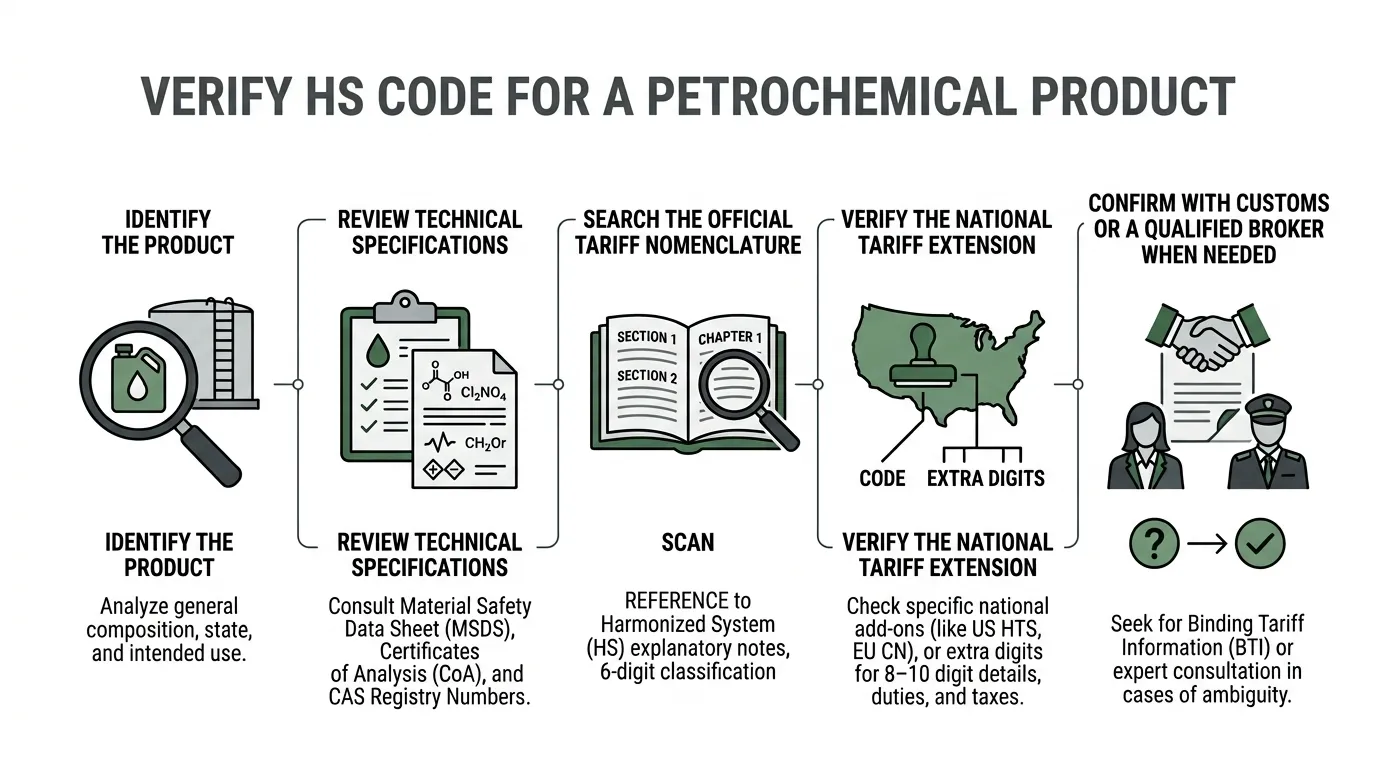
A reliable classification process starts with technical evidence and ends with verification against the importing country's rules.
Step 1: Identify the Product Precisely
Start with the product's full commercial and technical identity. Record the chemical name, grade, composition, purity, physical state, and intended application where relevant. For polymers, include the resin type and technical grade. For petroleum products, distinguish the relevant product category and characteristics. For chemical mixtures, identify the ingredients and their proportions where available. A generic description such as "industrial chemical" or "petrochemical material" is not sufficient for dependable classification.
Step 2: Review the Technical Documentation
Request the documentation needed to establish what the product actually is. Depending on the transaction, this may include:
Technical Data Sheet (TDS).
Safety Data Sheet (SDS).
Certificate of Analysis (COA), where applicable.
Product specification and grade information.
Composition or other supporting technical information when necessary.
These documents support the classification process, but none should be treated as an automatic guarantee of a particular HS code.
Step 3: Search the Official Tariff Nomenclature
Use the importing country's official customs tariff database to search by product description and candidate code. Check the full wording of the heading and subheading, as well as the applicable section and chapter notes. Do not rely exclusively on search-engine snippets, third-party code directories, supplier invoices, or codes used in previous shipments. A previous declaration may have been made under different circumstances or may not have been correct.
Step 4: Check the National Tariff Extension
After identifying a plausible six-digit HS subheading, determine how the destination country extends it into its national tariff code. The national code may affect duty rates, trade statistics, permits, and other import measures. Confirm the applicable version of the tariff schedule for the expected import date.
Step 5: Request a Customs Classification Decision if Needed
If the product is a complex mixture, a specialty preparation, a borderline case, or a high-value shipment, consider requesting a formal or advance classification ruling where the destination country offers that procedure. An advance ruling can help reduce uncertainty before the goods are shipped. The availability, eligibility criteria, and legal effect of such rulings vary by jurisdiction.
Step 6: Align the Shipping Documents
Once the classification has been verified, ensure that the product description and other required information are consistent across the relevant documents. The HS code should match the actual goods and the applicable customs declaration requirements. This final check is particularly important when coordinating suppliers, freight forwarders, customs brokers, and import teams.
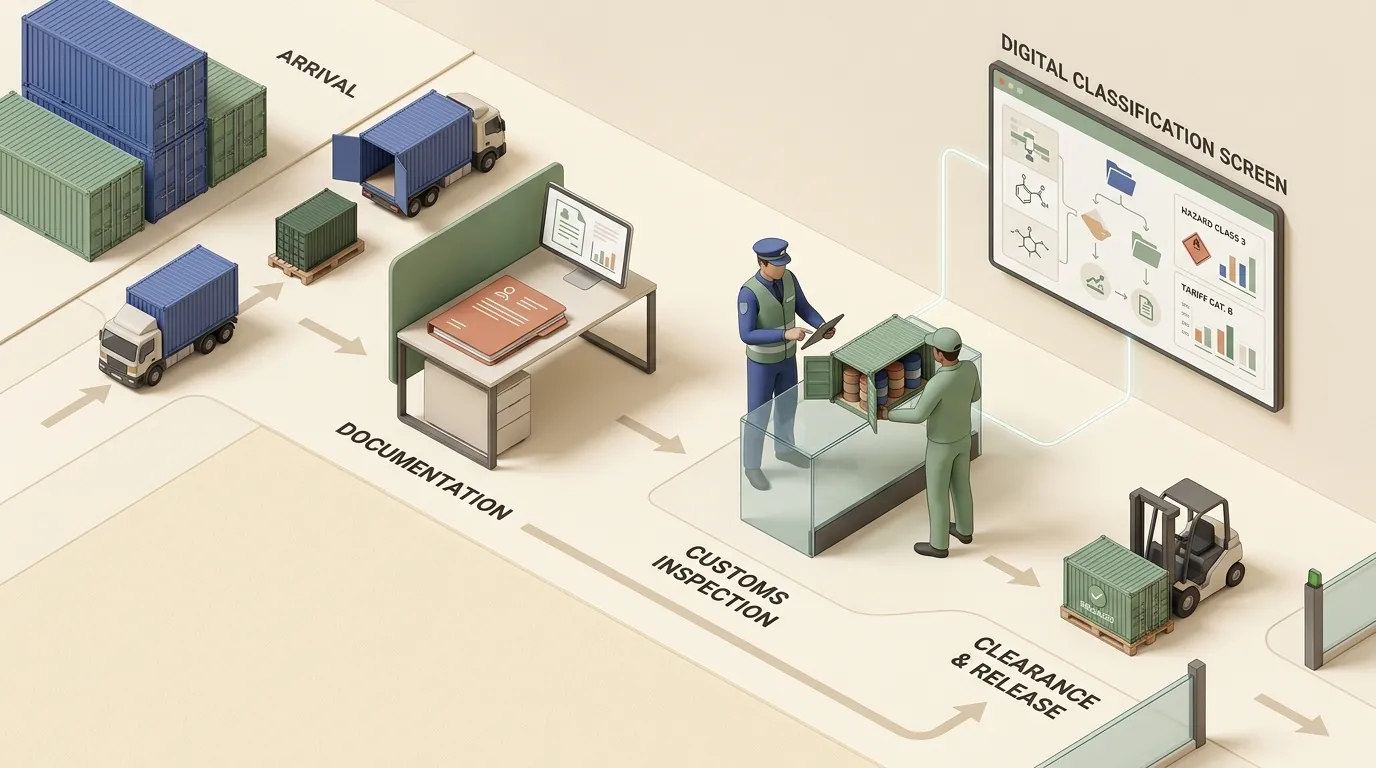
HS Codes, Product Specifications, and Shipping Documents
An HS code is only one part of a compliant import transaction. It does not replace the technical specification, commercial invoice, packing list, certificate of origin, transport document, or any required safety and regulatory paperwork.
Each document serves a different purpose:
Commercial invoice: Records the transaction details, seller, buyer, goods, quantities, and prices.
Packing list: Describes how the cargo is packed and identifies package quantities and related details.
Certificate of Analysis (COA): Reports test results against specified product parameters when provided for the transaction.
Safety Data Sheet (SDS): Provides safety and handling information for products covered by applicable requirements.
Certificate of Origin (COO): Certifies origin according to the relevant rules and issuing procedure.
Bill of Lading or other transport document: Records key information about the carriage of the goods.
The documents required for a particular shipment depend on the product, route, trade terms, and importing country's rules. For this reason, importers should establish document requirements before cargo dispatch rather than waiting until the shipment reaches the border.
For additional context on coordinating transport across borders, see TAV PETROIL's guide to cross-border transportation of petroleum and industrial products from Iran.
Common HS Classification Mistakes Importers Should Avoid
Even experienced buyers can encounter classification problems when product information is incomplete or commercial descriptions are too broad.
Using a Supplier's Code Without Verification
A supplier may provide an HS code on its quotation or invoice, but the importing authority is not necessarily bound by that classification. Verify the code independently against the destination country's rules.
Confusing Similar Product Names
Products with similar names may have different chemical compositions, uses, or levels of processing. Those differences can affect classification.
Treating a Six-Digit Code as the Complete National Code
The internationally harmonized six-digit level is not always sufficient for customs entry. Importers must check the national tariff extension and current requirements.
Ignoring Mixtures and Preparations
A product that contains multiple ingredients or has undergone additional processing may not be classified in the same way as a pure chemical or basic feedstock. The relevant legal notes and classification rules must be considered.
Copying Codes from Old Shipments
Tariff schedules can be amended, and earlier shipments may involve different product specifications or destination-country requirements. Recheck the code for each relevant product and market.
Checking Classification Too Late
If classification is reviewed only after the cargo has departed, resolving a dispute can become more complicated and expensive. Whenever possible, settle classification questions during the quotation and purchase-order stage.
How HS Classification Fits into Petrochemical Procurement
HS classification should be part of the procurement workflow, alongside product specifications, supplier documentation, Incoterms, and logistics planning.
Before confirming a purchase, an importer should establish:
The exact product name, grade, composition, and specification.
The proposed HS classification and the evidence supporting it.
The applicable tariff rate and other import measures in the destination market.
The required commercial, technical, transport, and regulatory documents.
The responsibilities of the buyer, supplier, freight forwarder, and customs broker.
The expected shipment route, packaging method, and delivery terms.
These checks help buyers evaluate the full transaction rather than focusing on the product price alone.
TAV PETROIL supports international buyers with oil and petrochemical supply and related trade coordination. Buyers can also explore the company's broader services to understand how sourcing and logistics requirements fit into an international supply arrangement.
The applicable classification, duties, import permits, and customs declarations should still be confirmed by the importer and its customs representative in the destination country.
The Role of HS Codes in International Oil Trading
In international energy and petrochemical markets, product classification connects commercial decisions with customs procedures and logistics planning. A reliable transaction requires agreement on what is being sold, how it is documented, and how it will be declared at the border. Classification is especially important when products with different specifications are traded under similar commercial descriptions or when shipments cross multiple jurisdictions. Buyers should also account for changing freight conditions, route constraints, and documentation requirements when calculating delivered cost.
For a broader discussion of the commercial forces shaping energy trade, read Global Oil Trading: Key Factors Shaping International Energy Markets.
Final Checklist Before Importing Petrochemical Products
Before releasing an order for shipment, confirm the following:
The product description matches its actual composition and specification.
The proposed HS code has been checked against an official source for the destination country.
The complete national tariff code has been verified where required.
Applicable duties, taxes, permits, and restrictions have been reviewed.
Commercial and technical documents are consistent.
The customs broker or relevant authority has been consulted if classification remains uncertain.
The shipping and delivery plan accounts for the destination's documentation and clearance requirements.
Correct HS classification cannot eliminate every customs risk, but it provides an important foundation for more predictable import planning. If your business is sourcing petroleum derivatives, petrochemical feedstocks, polymers, or other industrial products, establishing the correct product identity and classification early can help reduce avoidable uncertainty throughout the transaction.
To discuss sourcing and logistics requirements for an international order, visit TAV PETROIL's contact page.
Frequently Asked Questions (FAQ)
What is an HS code in international trade?
An HS code is a numerical classification used to identify traded goods under the Harmonized System maintained by the World Customs Organization. Countries use the system as the basis for their customs tariff classifications.
Are HS codes the same in every country?
The first six digits are internationally harmonized at the HS level, but countries may add more digits for national tariff lines. Duty rates and additional import measures can also vary by country.
Do all petrochemical products fall under Chapter 27?
No. Chapter 27 covers mineral fuels, mineral oils, and certain related products, while many organic chemicals, fertilizers, and polymers are classified in other chapters. The correct classification depends on the product and the applicable legal rules.
Can I use the HS code provided by my supplier?
Use it as a starting point, not as final confirmation. Verify the code against the official tariff schedule of the importing country, particularly when the goods are high-value, regulated, or difficult to classify.
Which documents help identify a petrochemical product for customs classification?
Depending on the product, useful documents can include a Technical Data Sheet, Safety Data Sheet, Certificate of Analysis, product specification, and composition information. Customs authorities may request additional evidence.
Where can I verify an HS code?
Start with the official customs tariff database of the importing country and consult the World Customs Organization's HS nomenclature resources. If the classification remains uncertain, ask the customs authority or a qualified customs broker about formal classification procedures.
Can an incorrect HS code delay customs clearance?
Yes. An incorrect or unsupported classification can lead to requests for information, reassessment, document amendments, or other consequences under local law. The actual outcome depends on the jurisdiction and circumstances of the shipment.
Disclaimer: This article is for general informational purposes and does not constitute a binding customs classification, legal opinion, or tariff determination. Product classification and import requirements must be verified against the current rules of the relevant jurisdiction before shipment.