
Asian Bitumen Export Prices Rise in Early October 2026 Amid Tight Supply
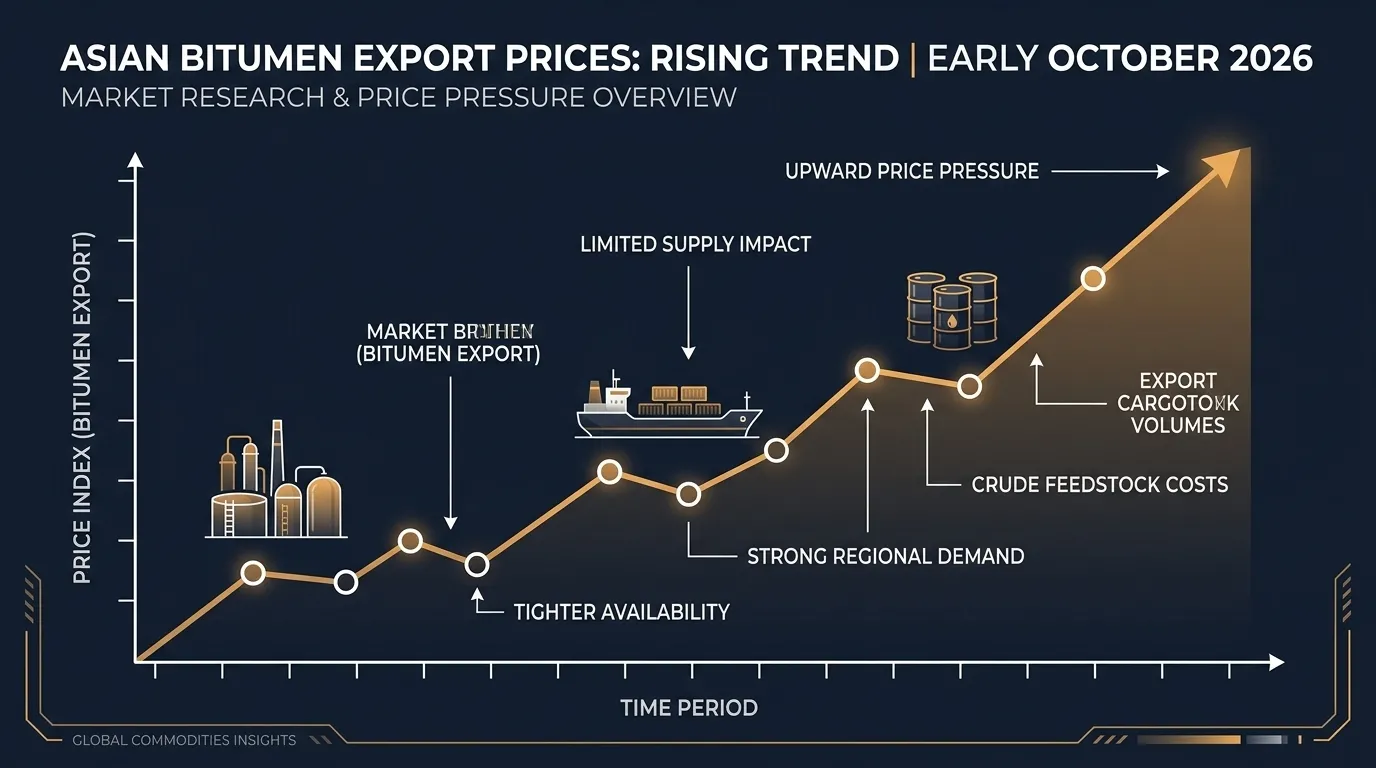
Asian bitumen export prices strengthened at the start of October as limited cargo availability in Singapore and South Korea made it harder for buyers to secure supplies for upcoming shipments. In its October 3 market update, Tiger Bitumen reported firmer export prices across parts of Asia during the week ending October 2. The report pointed to restricted availability of suitable crude feedstock and stronger crude oil and fuel oil values as key factors influencing the market. Conditions elsewhere were more mixed, with European and Mediterranean markets showing different price trends. For importers, distributors, and road construction contractors, the latest movement highlights an important feature of the bitumen trade: regional prices do not always move together, even when markets are exposed to some of the same feedstock and shipping pressures.
Source: Tiger Bitumen — Bitumen Market Update, October 3, 2026.
Asian Supply Constraints Put Export Markets Under Pressure
Singapore remains an important export and trading hub for bitumen in Asia. When fewer cargoes are available, buyers that depend on seaborne supply may have to compete for a smaller pool of material or consider alternative origins. The early-October update identified tighter availability in both Singapore and South Korea. Limited access to heavier crude grades was among the factors affecting production, as these feedstocks are relevant to bitumen manufacturing at many refineries. The issue is not simply whether crude oil is available in the market. Refineries need feedstocks that suit their production configuration and the specifications of the products they intend to make. If suitable crude becomes harder to source, output may be constrained even when other crude grades remain available. At the same time, firmer crude and fuel oil values can affect refinery economics and the prices at which producers are prepared to offer bitumen. When these cost pressures coincide with limited export availability, buyers may face a narrower range of offers and less flexibility when negotiating prompt shipments. The market update describes these pressures as part of the reason Asian export values moved higher in early October. It does not establish that every supplier or destination experienced the same increase.
Singapore and South Korea Remain Key Markets to Watch
The supply picture in Asia is particularly relevant for buyers monitoring Singapore-origin and South Korean bitumen cargoes. When availability from these origins tightens, importers may need to reassess their preferred loading windows, compare offers from other producers, or secure material earlier than planned. These decisions depend on the destination, grade, shipment size, and timing of the project. However, a higher regional benchmark does not automatically translate into the same increase in every delivered market. Freight, insurance, packaging, port charges, financing, and destination-specific demand can all affect the final cost. Buyers should also distinguish between bulk cargo prices and prices for bitumen supplied in drums or other packaging. These products may have different handling, transport, and delivery costs, so their prices should not be compared without accounting for the commercial basis.

For a wider introduction to product grades, applications, testing, and handling, see TAV PETROIL's guide to bitumen types, uses, tests, and applications.
Not Every Region Is Following the Same Trend
While Asian export markets faced tighter availability, the early-October report described a different picture in Europe and the Mediterranean. Northwest European truck-delivered prices moved higher as refiners passed through earlier gains in fuel oil values. Mediterranean cargo prices, by contrast, were broadly steady, with surplus supply limiting the upward pressure seen in parts of Asia. Markets in sub-Saharan Africa also strengthened, supported in part by seasonal demand patterns. These differences matter for international buyers. A price increase in one export hub should not be treated as proof that prices are rising at the same pace worldwide. Regional supply balances, transport costs, construction activity, and the timing of seasonal demand can produce different outcomes. For buyers sourcing material across more than one region, comparing current offers on a like-for-like basis is more useful than relying on a single headline market direction.
Seasonal Demand Adds Another Variable
Bitumen demand is closely linked to road construction and maintenance schedules. Weather conditions and project timing can therefore influence purchasing activity from one region to another. As the fourth quarter begins, some markets enter periods of active road construction, while others approach the end of their main paving season. These seasonal differences can affect how urgently buyers need cargoes and how much inventory distributors are willing to carry. Where project deadlines are fixed, importers may be more willing to pay a higher price to secure confirmed supply. Buyers with flexible schedules may instead delay purchases, reduce order sizes, or monitor alternative sources. Neither approach is suitable for every business. The right decision depends on the cost of a delayed project, available inventory, supplier reliability, and the risk that replacement cargoes could become more expensive or harder to obtain.
What the Market Shift Means for Bitumen Importers
The early-October developments offer several practical considerations for companies buying bitumen internationally.
Recheck Quotations and Validity Periods
In a changing market, a quotation should be assessed alongside its validity period, confirmed availability, loading window, and delivery terms. An indicative offer is not the same as a confirmed cargo allocation. Buyers should clarify whether a quoted price applies to bulk or packaged material and whether it is based on FOB, CFR, or CIF terms. Comparing offers with different delivery bases can produce misleading conclusions about which supplier is more competitive. For a refresher on the commercial responsibilities associated with international shipments, read TAV PETROIL's guide to cross-border transportation of petroleum and industrial products from Iran.
Compare Alternative Origins Carefully
When a preferred supply source becomes less available, importers may consider offers from other producing countries or export hubs. However, the lowest quoted price does not necessarily represent the lowest landed cost. Before switching origins, buyers should compare product specifications, test documentation, packaging, shipment size, transit time, insurance, port compatibility, and the reliability of the proposed loading schedule. A product that is cheaper at the loading port may become less competitive after freight and handling are included. Equally, an alternative origin may be commercially attractive if it offers more dependable availability or a delivery schedule better suited to the buyer's requirements.
Build Freight and Delivery Risk into Procurement
Shipping conditions can influence the final economics of a bitumen purchase, particularly when buyers rely on specific routes, ports, or shipment windows. Importers should confirm the responsibilities of the seller and buyer, the documents needed for customs clearance, and the practical arrangements for transporting and unloading the cargo. These details become especially important when comparing offers from different origins.
TAV PETROIL provides information about its transportation and delivery services for buyers assessing international supply arrangements.
Avoid Treating Market Headlines as a Price Guarantee
A report that prices have risen does not mean every supplier will immediately increase every offer by the same amount. Contract terms, inventory positions, product grade, packaging, destination, and shipment timing all influence the price available to a particular buyer. Importers should use market news as a signal to review their purchasing plans, not as a substitute for current quotations and confirmed offers.
The Wider Picture for Global Bitumen Trade
Bitumen markets are influenced by several connected factors: refinery feedstock availability, competing fuel-product economics, seasonal construction demand, export availability, and the cost and reliability of transportation. These factors can interact differently across regions. A supply shortage in one export hub may encourage buyers to look elsewhere, but alternative sources may have their own production constraints, quality requirements, or logistical limitations. The wider oil market also matters because crude oil and refinery-product values can influence the economics of producing and trading bitumen. For additional context, read TAV PETROIL's analysis of global oil trading and the factors shaping international energy markets. Changes in supply availability can also have consequences beyond an individual product market. For more background on the relationship between logistics, feedstocks, and broader commodity movements, see Petrochemical Supply Chains Under Pressure in 2026.

What Buyers Should Monitor Next
As October progresses, buyers will want to watch whether export availability from Singapore and South Korea improves, whether suitable crude feedstocks become easier for refineries to secure, and whether seasonal demand continues to support prices in key importing regions. They should also monitor the difference between indicative market assessments and firm supplier quotations. A headline benchmark can help establish direction, but it cannot confirm that a specific grade, quantity, packaging format, or loading date is available. For companies evaluating Iranian-origin material, TAV PETROIL provides information about its Iranian bitumen supply and export offering, alongside its broader oil and petrochemical supply services and company services. Actual availability, specifications, shipment terms, and pricing should be confirmed for each enquiry.
Businesses planning a purchase can contact TAV PETROIL to discuss their product requirements and delivery needs.
Frequently Asked Questions
Why did Asian bitumen export prices rise in early October 2026?
Tiger Bitumen's October 3 market update attributed the increase during the week ending October 2 to tighter availability in Singapore and South Korea, limited access to suitable heavy crude feedstocks, and firm crude and fuel oil values.
Which Asian markets were affected by tighter bitumen supply?
The report highlighted Singapore and South Korea as markets where export availability had tightened. Conditions may vary by producer, grade, shipment window, and destination.
Did bitumen prices increase in every region?
No. The report described higher prices in parts of Asia and Northwest Europe, broadly steady Mediterranean cargo prices, and firmer conditions in some sub-Saharan African markets. Regional price movements were not uniform.
Does an increase in FOB prices mean delivered prices will rise by the same amount?
Not necessarily. Delivered prices also depend on freight, insurance, packaging, port charges, shipment size, delivery terms, and destination-market conditions.
What should importers do when export supply becomes tight?
Importers should confirm cargo availability and quotation validity, review shipment timing, compare alternative origins on a like-for-like basis, and check that product specifications and documentation meet destination requirements.
Is this report a current price quotation for bitumen?
No. It is a dated market update describing reported price direction and supply conditions during the week ending October 2, 2026. Buyers should obtain a current, product-specific quotation before making a purchasing decision.