
Industrial mineral specifications often use terms such as mesh size, micron size, D50, and D97 to describe particle dimensions. Although these terms are related, they do not represent the same measurement.
Understanding the difference is essential when purchasing materials such as calcium carbonate, barite, bentonite, and fluorite. Incorrect interpretation of particle-size specifications can lead to inconsistent product quality, processing difficulties, and disputes between buyers and suppliers.
This guide explains how mesh and micron measurements work, how to interpret particle-size data, and what to check before confirming an industrial mineral order.
1. What Is Mesh Size?
Mesh size describes the number of openings per linear inch in a sieve screen. A higher mesh number generally indicates smaller sieve openings.
For example, a 100-mesh sieve has more openings per inch than a 20-mesh sieve. However, mesh number alone does not describe every characteristic of the particles passing through it. Wire thickness, sieve standards, and the particle-size distribution of the material also matter.
Mesh specifications are commonly used in mineral processing, powder production, and industrial material trading.
2. What Is Micron Size?
A micron, also called a micrometre and written as µm, is a unit of length used to measure small particles.
-
1 micron (µm) = 0.001 millimetres (mm)
-
1 millimetre (mm) = 1,000 microns (µm)
Micron measurements are especially useful for fine mineral powders, where particle dimensions may be too small to describe meaningfully through ordinary visual inspection.
For industrial applications, a specification such as 45 µm communicates a particle dimension in a direct unit of length. However, buyers should still establish whether the figure refers to a sieve aperture, a nominal particle size, or a parameter from a particle-size distribution report.
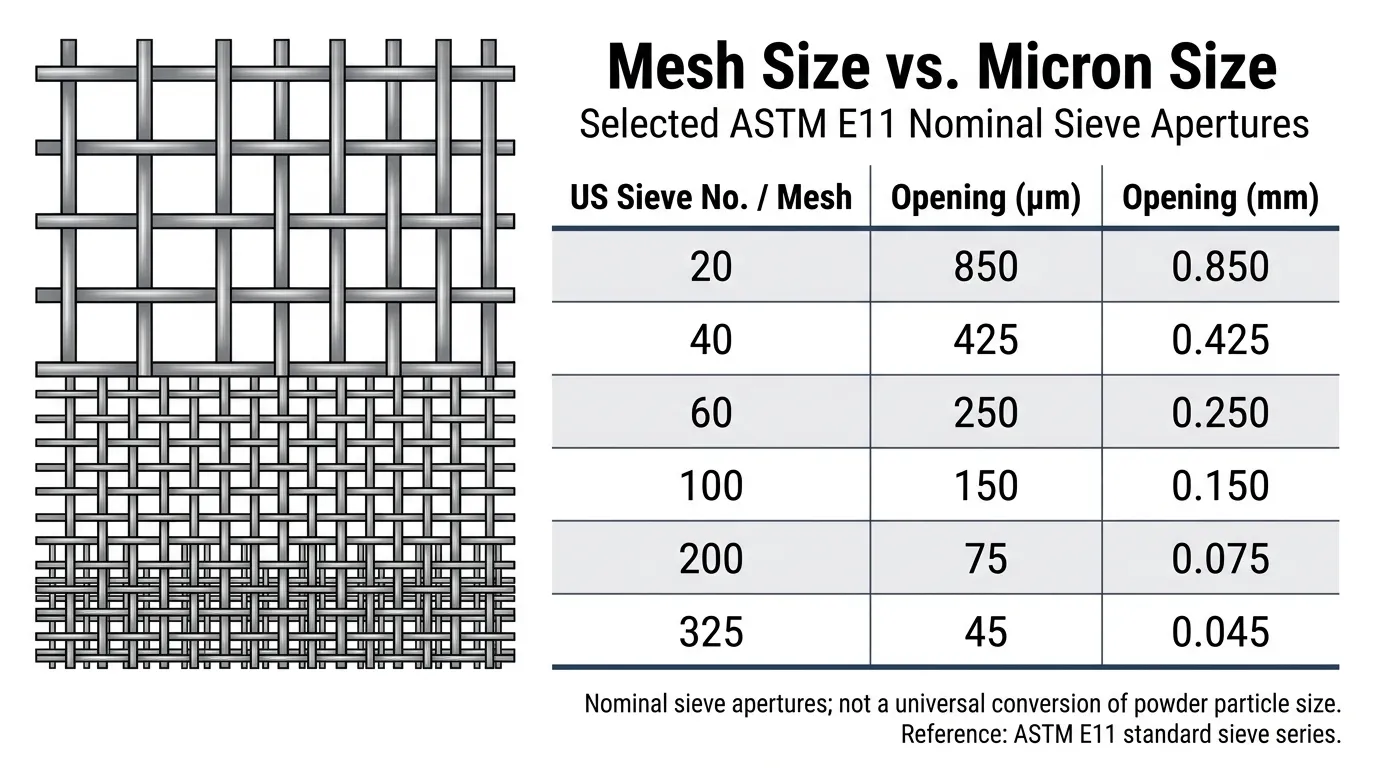
3. Mesh-to-Micron Reference Chart
The following table provides approximate sieve-opening values based on commonly used US standard sieve references.
| Mesh size | Approximate sieve opening |
|---|---|
| 20 mesh | 850 µm |
| 40 mesh | 425 µm |
| 60 mesh | 250 µm |
| 100 mesh | 150 µm |
| 200 mesh | 75 µm |
| 325 mesh | 45 µm |
These values are useful reference points, not universal conversions for every commercial powder grade. Sieve-opening values depend on the applicable standard, and the aperture is not necessarily the same as the measured diameter of every particle in a powder sample.
Important: Commercial descriptions such as 450 mesh, 800 mesh, 1,500 mesh, or 2,500 mesh may be supplier-specific fine-powder designations. Do not assume they correspond to actual standard sieve openings without checking the technical documentation.
For formal sieve specifications, buyers can consult ASTM E11 standard information and confirm which standard the supplier uses.

4. Why Mesh and Microns Are Not Always Interchangeable
Mesh and microns describe particle size from different perspectives. Mesh relates to the openings in a sieve, while microns express a length.
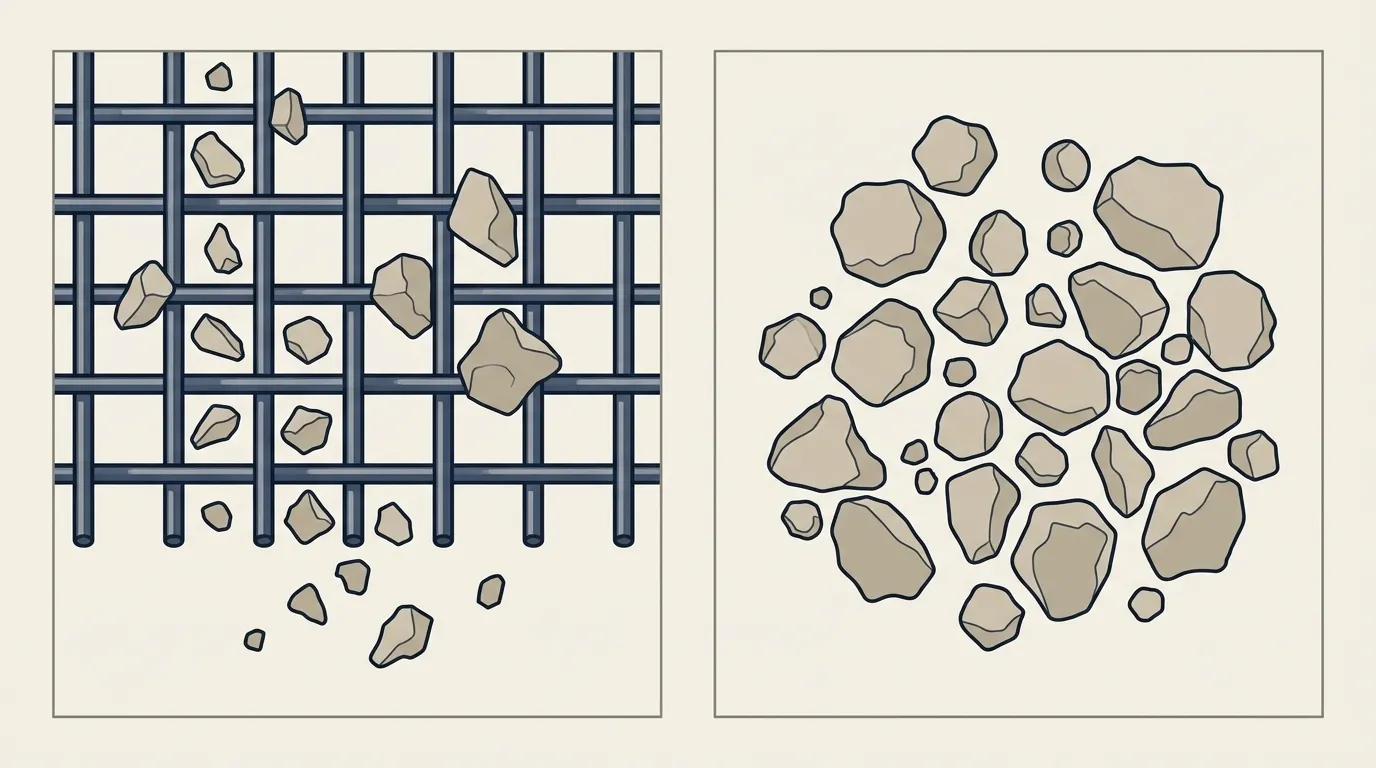
A sieve test determines how material behaves when passed through a screen with specified openings. A particle-size analyser, by contrast, estimates particle dimensions according to the instrument's measurement principles and reporting method.
This distinction becomes particularly important when comparing fine industrial powders from different suppliers. Two products advertised with the same mesh designation may have different particle-size distributions, depending on the supplier's classification method and manufacturing process.
When comparing quotations, buyers should request the exact particle-size definition rather than relying on a mesh number alone.
5. Understanding D50, D90, and D97
Fine mineral powders are often described using particle-size distribution parameters.
-
D50: The particle diameter at or below which 50% of the measured particle population falls, according to the report's stated basis.
-
D90: The diameter at or below which 90% falls.
-
D97: The diameter at or below which 97% falls.
For example, a powder specification may state D50 = 8 µm and D97 = 25 µm. This indicates that the reported median particle size is 8 µm and that 97% of the measured distribution falls at or below 25 µm, according to the specified measurement basis.
These figures describe different parts of the distribution. D50 alone does not show how many relatively coarse particles are present, so D90 or D97 may also be important when an application requires tighter control over the coarser fraction.
Always check the test method and whether the results are reported by volume, number, or another basis.
6. How Particle Size Affects Industrial Minerals
Particle size can influence processing behaviour, product performance, and suitability for a particular application. The relevant limits depend on the material and its intended use.
Calcium Carbonate
Calcium carbonate particle size can affect dispersion, surface finish, processing behaviour, and performance in applications such as plastics, coatings, and other industrial formulations. Buyers should check the required size distribution and whether the product is coated or uncoated.
Barite
For barite used in drilling-related applications, particle-size distribution is one of several factors that may influence suspension behaviour and suitability. Buyers should also review density, chemical composition, moisture, and the relevant application-specific requirements.
Bentonite
Bentonite performance depends on more than particle size. Mineral composition, swelling behaviour, moisture, and other application-specific properties may be equally important. A mesh designation should therefore be considered alongside the full technical specification.
Fluorite
For industrial fluorite, particle size may affect suitability for a particular process or downstream application. Buyers should confirm the required grade, chemical purity, size distribution, and any limits on impurities before placing an order.
For broader sourcing requirements, explore TAV PETROIL's industrial and technology solutions, which support industrial material and product requirements according to project specifications.
7. How to Evaluate a Supplier's Particle-Size Specification
Before accepting a quotation or approving a shipment, ask the supplier to clarify the following points:
-
Measurement unit: Is the size given in mesh, microns, or both?
-
Applicable standard: Which sieve or particle-size measurement standard is used?
-
Distribution parameters: Are D50, D90, or D97 available where relevant?
-
Test method: Was the size determined by sieve analysis, laser diffraction, or another method?
-
Other quality characteristics: What are the limits for purity, moisture, density, or other application-specific properties?
-
Technical documentation: Can the supplier provide a Technical Data Sheet (TDS) and a Certificate of Analysis (COA) for the offered grade?
-
Commercial consistency: Will the delivered batch be checked against the agreed specification?
Laser diffraction is commonly used for many fine powders, but it is not the only possible method. The appropriate method depends on the material, particle characteristics, applicable standard, and intended application.
A clear written specification helps both parties evaluate whether the supplied material meets the buyer's requirements.
8. Packaging and Handling: Why Specifications Matter Beyond the Laboratory
Correct particle-size information is only one part of a successful industrial mineral order. Packaging, handling, storage, and transportation requirements should also match the material and the destination.
For example, moisture-sensitive or fine powders may require suitable packaging and careful handling to reduce contamination, moisture exposure, or product loss. The appropriate solution depends on the material, packaging format, route, and shipment conditions.
TAV PETROIL coordinates product preparation and shipment requirements through its Packaging & Handling services. These requirements should be agreed alongside the product specification, rather than addressed only after the order has been confirmed.
You can also review the company's broader oil, petrochemical, and industrial services for supply and coordination requirements.
Frequently Asked Questions
Is a higher mesh number finer or coarser?
A higher mesh number generally means smaller sieve openings. However, a mesh designation should be interpreted using the applicable sieve standard and the supplier's definition.
How many microns are in one mesh?
There is no universal conversion in which one mesh equals a fixed number of microns. Mesh refers to sieve openings, while microns are a unit of length. A reference chart can provide approximate sieve-opening values for specific standards.
What is the approximate opening of a 325-mesh sieve?
A commonly used reference value for a 325-mesh sieve is approximately 45 µm. Confirm the applicable standard before using this figure as a contractual specification.
What is the difference between D50 and D97?
D50 describes the median of the reported particle-size distribution. D97 indicates the diameter at or below which 97% of the measured distribution falls, according to the report's stated basis. D97 can help buyers assess the coarser portion of a fine powder.
Should buyers specify mesh or microns?
The best choice depends on the product, application, and measurement method. For standard sieve-based materials, mesh may be appropriate. For fine powders, a micron-based specification with clearly defined distribution parameters may provide more useful detail. In either case, the test method and acceptance criteria should be stated.
What documents should buyers request?
Depending on the product and application, buyers should request a Technical Data Sheet, a Certificate of Analysis, the applicable test method, and confirmation that the delivered batch will meet the agreed specification.
Conclusion
Mesh size and micron size are related, but they are not interchangeable in every commercial context. Mesh describes sieve openings, while microns express a length. For fine industrial minerals, particle-size distribution parameters such as D50 and D97 can provide additional information that a single mesh designation cannot.
Before purchasing calcium carbonate, barite, bentonite, fluorite, or other industrial materials, confirm the measurement method, applicable standard, distribution parameters, and complete quality specification. Clear technical requirements help buyers compare offers accurately and reduce the risk of receiving material that does not suit the intended application.
If you need help coordinating industrial material sourcing or shipment requirements, contact TAV PETROIL to discuss your product specifications, quantity, destination, and delivery requirements.