
Base Oil: Types, Grades, Properties & Industrial Applications
Base oil is one of the most important raw materials used in the production of lubricants. It provides the fundamental properties of a finished lubricant, including viscosity, temperature performance, oxidation resistance, and stability.
Base oils are commonly produced from petroleum fractions, while synthetic and bio-based alternatives are also available for applications requiring specific performance characteristics.
For lubricant manufacturers and industrial buyers, understanding base oil types and grades is essential when selecting a product for a particular application.
What Is Base Oil?
Base oil is the primary component used to formulate lubricants, engine oils, industrial oils, greases, and various specialty fluids.
The final lubricant is normally produced by combining one or more base stocks with carefully selected additives. The base oil provides the foundation, while additives are used to improve or modify characteristics such as oxidation resistance, wear protection, corrosion control, and detergent performance.
The required base oil depends on factors such as:
- Operating temperature
- Required viscosity
- Equipment load and speed
- Oxidation stability
- Low-temperature performance
- Compatibility with additives
- Intended industrial application
Main Types of Base Oil
Base oils can generally be divided into three broad categories:
1. Mineral Base Oil
Mineral base oils are derived from crude oil through refining processes. They remain widely used because of their availability, versatility, and suitability for a broad range of lubricant formulations.
Mineral base oils can be produced with different characteristics depending on the crude feedstock and refining technology.
2. Synthetic Base Oil
Synthetic base oils are produced through chemical processes designed to create specific molecular structures and performance characteristics.
Examples include:
- Polyalphaolefins (PAO)
- Esters
- Polyalkylene glycols (PAG)
Synthetic base oils are often selected for applications requiring high thermal stability, low-temperature performance, or extended lubricant life.
3. Bio-Based Base Oil
Bio-based oils are produced from renewable feedstocks such as vegetable oils and other biological sources.
They can offer biodegradability and environmental advantages, although their suitability depends heavily on the application and required performance characteristics.
API Base Oil Groups Explained
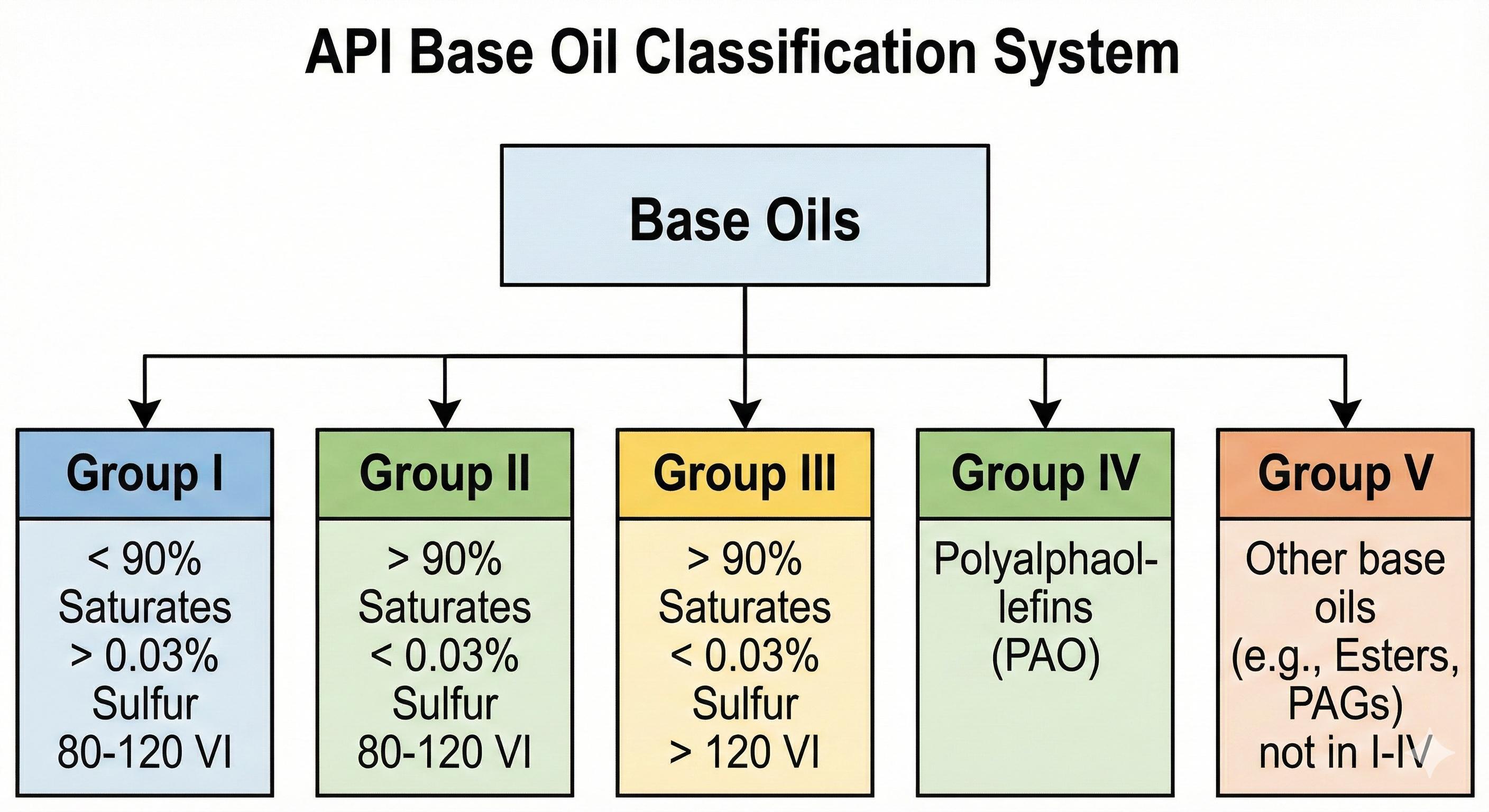
One of the most widely used systems for classifying lubricant base stocks is the API Base Oil Classification.
The system divides base stocks into five groups: Group I, Group II, Group III, Group IV, and Group V. The classification considers characteristics such as refining process, viscosity index, sulfur content, and saturates.
Group I Base Oil
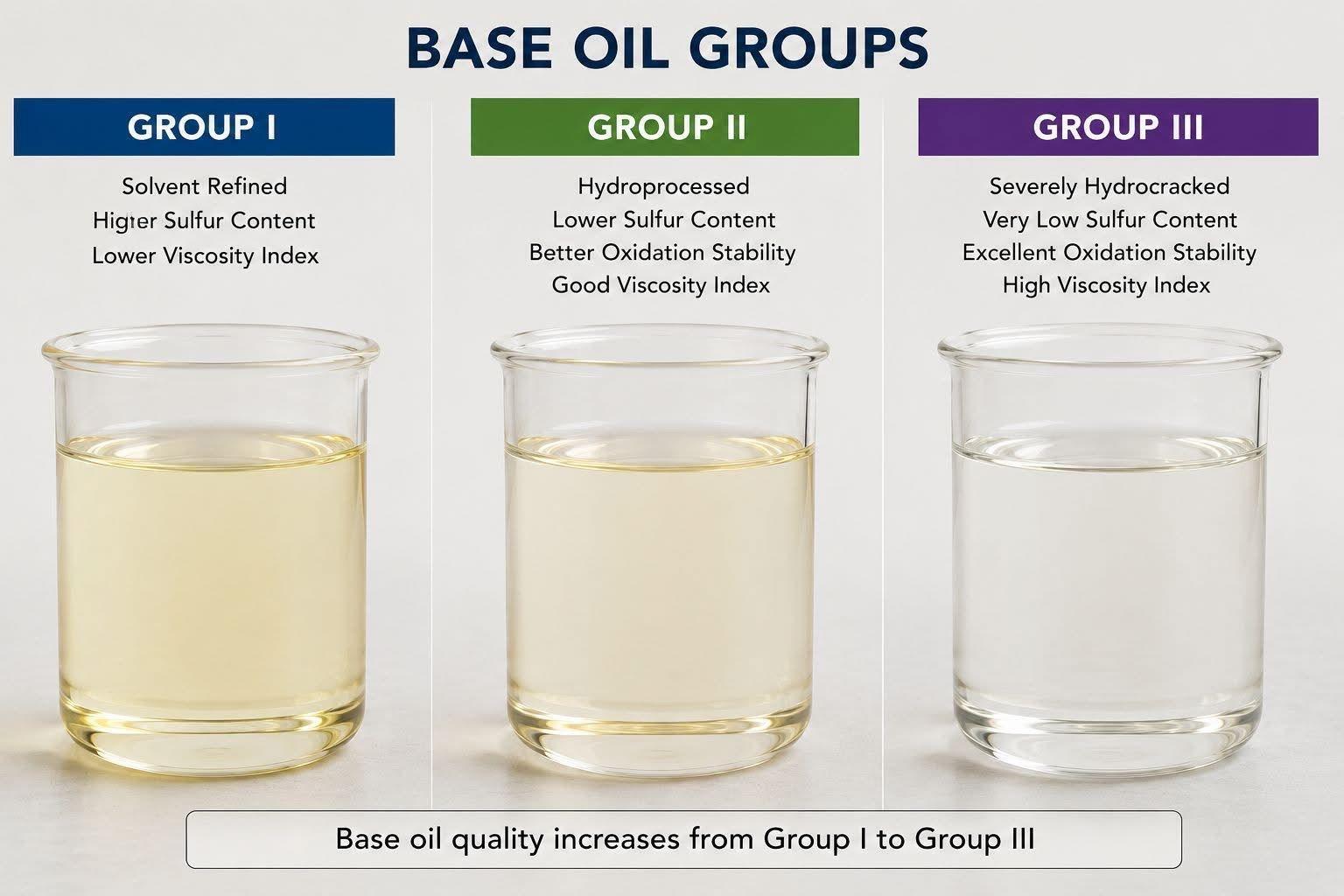
Group I base oils are conventional mineral base oils produced using processes such as solvent refining and hydrofinishing.
They offer a broad viscosity range and are used in various industrial and automotive lubricant formulations.
Typical applications include:
- Industrial lubricants
- Marine lubricants
- Automotive lubricants
- Process oils
Group II Base Oil
Group II base oils are produced using hydroprocessing technologies that provide higher purity and improved oxidation stability compared with conventional Group I stocks.
They are widely used in modern lubricant formulations, including:
- Engine oils
- Hydraulic fluids
- Turbine oils
- Compressor oils
- Industrial lubricants
Group II base oils are also widely used in formulations where improved stability and performance are required.
Group III Base Oil
Group III base oils undergo advanced refining and hydroprocessing, resulting in highly refined base stocks with high viscosity index and strong temperature and oxidation performance.
They are commonly used in:
- High-performance engine oils
- Transmission fluids
- Industrial lubricants
- High-temperature applications
Group III base oils are particularly relevant where manufacturers require higher-performance lubricant formulations.
Group IV Base Oil
Group IV consists primarily of Polyalphaolefins (PAOs), which are synthetic base stocks produced through chemical synthesis rather than conventional crude oil refining.
PAOs are valued for properties such as:
- High thermal stability
- Good low-temperature performance
- Low volatility
- High oxidation resistance
They are used in high-performance automotive and industrial lubricants.
Group V Base Oil
Group V includes base stocks that do not fall within Groups I–IV.
This category covers several specialty synthetic fluids, including certain:
- Esters
- PAGs
- Silicone fluids
- Specialty synthetic oils
Their properties can vary significantly depending on their chemical composition and intended application.
Important Base Oil Properties
When selecting base oil, several technical properties need to be considered.
Viscosity
Viscosity describes a fluid's resistance to flow. It is one of the most important parameters when selecting a base oil for a lubricant formulation.
Viscosity Index
Viscosity index indicates how significantly the viscosity of an oil changes with temperature. A higher viscosity index generally means more stable viscosity across changing operating temperatures.
Pour Point
Pour point represents the lowest temperature at which an oil can flow under specified test conditions.
A low pour point is particularly important for applications exposed to cold environments.
Flash Point
Flash point is related to the temperature at which an oil produces sufficient vapor to ignite under specified test conditions. It is an important consideration for handling and high-temperature applications.
Oxidation and Thermal Stability
Resistance to oxidation and thermal degradation is important for lubricants operating at elevated temperatures or for extended periods.
These properties depend on the base oil's composition, refining technology, and formulation.
How Is Base Oil Produced?
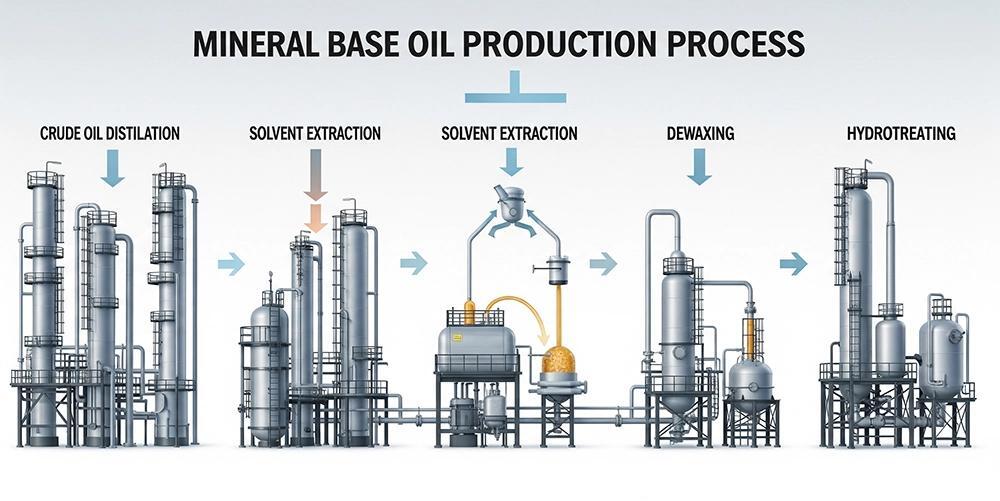
Mineral base oils are generally produced from selected petroleum fractions.
A simplified production process can include:
Crude Oil → Distillation → Vacuum Distillation → Refining/Hydroprocessing → Dewaxing → Hydrofinishing → Base Oil
During refining, undesirable compounds and impurities are removed or transformed to improve characteristics such as stability, viscosity behavior, color, and low-temperature performance.
The exact process depends on the desired base oil group and specifications.
Applications of Base Oil
Base oils are used across a wide range of industries because they form the foundation of many lubricant formulations.
Automotive
Base oils are used in:
- Engine oils
- Transmission fluids
- Gear oils
- Hydraulic fluids
- Greases
Industrial
Industrial applications include:
- Hydraulic oils
- Compressor oils
- Turbine oils
- Gear lubricants
- Metalworking fluids
Marine
Base oils are used in lubricants designed for marine engines, machinery, and other equipment operating in demanding environments.
Agriculture and Heavy Equipment
Agricultural machinery, construction equipment, mining machinery, and other heavy-duty systems also rely on lubricants formulated with appropriate base oils.
Base stocks can account for a substantial portion of finished lubricants, making their quality and selection critical to the final product's performance.
How to Choose the Right Base Oil
There is no single base oil that is suitable for every application.
The appropriate selection depends on:
- Required viscosity
- Operating temperature
- Equipment type
- Load and operating conditions
- Required oxidation stability
- Additive compatibility
- Finished lubricant specifications
- Cost and availability
For commercial buyers, technical specifications and consistent supply are equally important.
Base Oil Supply for International Markets
The international base oil market connects refineries, traders, lubricant manufacturers, distributors, and industrial consumers across multiple regions.
For buyers, reliable sourcing involves more than simply identifying a suitable grade. Product specifications, packaging, transportation, documentation, delivery terms, and destination requirements can all affect the success of a shipment.
TAV PETROIL supports customers with oil and petrochemical sourcing, supply, packaging, transportation, and international trading solutions.
FAQ
What is base oil used for?
Base oil is primarily used as the foundation for manufacturing lubricants, engine oils, industrial oils, greases, and specialty fluids.
What are the main API base oil groups?
The API classification includes five groups: Group I, Group II, Group III, Group IV, and Group V. Each group has different characteristics based on its composition and production method.
What is the difference between Group I and Group II base oil?
Group II base oils are produced using more advanced hydroprocessing and generally offer higher purity and better oxidation stability than conventional Group I base oils.
How does TAV PETROIL supply base oil?
TAV PETROIL coordinates the sourcing and supply of oil and petrochemical products according to customer requirements, including product specifications, packaging, transportation, and delivery arrangements.
Looking for a Reliable Base Oil Supply Partner?
TAV PETROIL provides sourcing and supply solutions for base oils, helping manufacturers, lubricant producers, and industrial buyers access suitable products based on required specifications, quantity, packaging, destination, and delivery terms. Our services can also include packaging, transportation, and international supply coordination to support your requirements from sourcing to delivery.
Contact our team to discuss your base oil requirements and explore the right supply solution for your business.